

EN
September 21, 2026
How do card-linked offers work?
What platforms support card-linked offers?
Examples of card-linked rewards
Get a monthly loot box of insights straight to your email!
Subscribe
app-pulishers
Card-linked offers, or CLOs, are a powerful channel in performance marketing. Retailers fund the rewards, finance apps surface them, and customers have rewards flow directly from the retailer to the credit card with no extra step needed.
And their benefits are two-sided: retailers get exposure to new clients and increased chances of revenue, while finance apps can use them as an additional engagement and monetization layer. In fact, they get a share of revenue for hosting card-linked offers on their channels.
In this article, we'll cover what card-linked offers are, how they work, which platforms power them, and how they compare to models like app-linked cashback and game-linked rewards.
👀 Ready to boost your app engagement with gamification? Take a look here: How gamification can turn your fintech app into a daily app
Card-linked offers (CLOs) are rewards that are tied directly to a customer's existing debit or credit card. Customers link their card to a program or a banking app, retailers fund the rewards, and the reward is then applied automatically the next time they use that card at a featured retailer.
Because the transaction itself serves as the mechanism for attribution, CLOs can give retailers a better understanding of their campaigns' ROI than traditional digital advertising. On the other hand, for banks and fintechs, they can create an additional engagement and monetization opportunity by bringing partner-funded rewards into the customer experience.
In other words:
The CLO model is rather successful. According to a survey from the Digital Commerce Alliance, 25% of businesses running card-linking programs reported growth of over 100% in a single year. And on the consumer side, PYMNTS Intelligence found that 74% of premium cardholders have redeemed at least one card-linked offer in the last year.
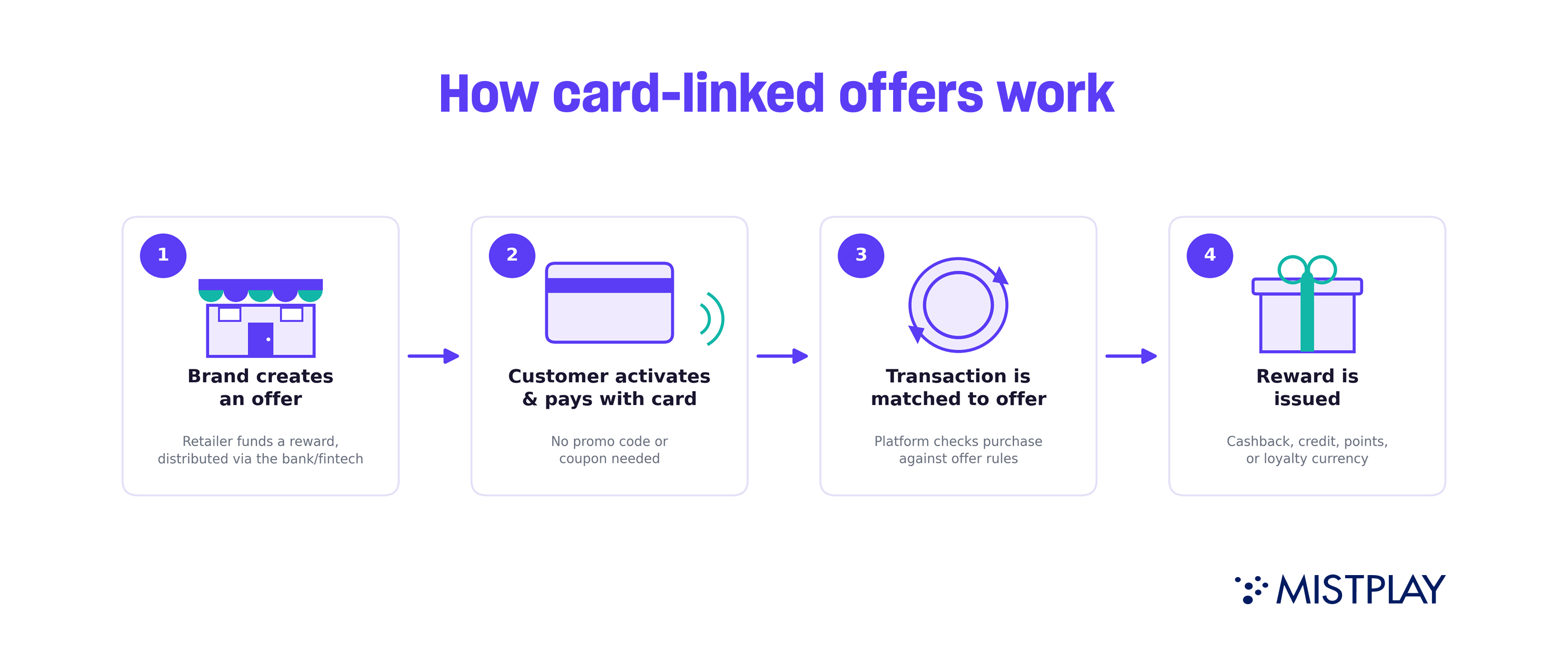
Card-linked offers connect a partner-funded reward to a customer’s payment card. Though the process is quite simple, there are several steps that make CLOs work.
1. A brand creates an offer: A retailer or brand creates an offer and partners with the bank or fintech provider to distribute it to their loyalty members. The brand is also responsible for funding the reward. Customers may see offers based on factors such as their shopping behavior, location, or existing relationship with the financial institution.
2. The customer activates the offer and makes a purchase: There are two ways for an offer to be activated. In an opt-in model, the customer needs to manually activate the offer, but some CLO programs can work without an explicit activation step. In this case, they can just make a purchase at the participating retailer using the linked card. Customers don't generally need to enter a promo code or show a coupon at checkout, which makes redeeming the reward more straightforward.
3. The transaction is matched to the offer: A third-party platform, which matches the offers with the financial institution, receives transaction data and checks whether the purchase meets the offer's conditions, such as the retailer, purchase amount, date, or eligible card.
4. The reward is issued: If the transaction qualifies, the cashback or other reward is credited to the customer, often as a statement credit, cash reward, points, or another loyalty benefit.
The CLO space is a layered ecosystem, where different companies work together to provide customers with relevant offers. On the one hand, we have banks and credit card issuers, who sit close to the customers; on the other, third-party platforms, which connect brands with financial institutions.
Banks and credit card issuers act as publishers, meaning that they host the offers on their apps, giving their customers the opportunity to browse and choose the reward they want. They are the closest operator to the end customer.
Some popular examples are Chase Offers, American Express Offers, Bank of America's BankAmeriDeals, and Citi Merchant Offers. These financial institutions require the cardholder to browse deals and activate them on a specific card before a purchase counts.
The card networks themselves have also moved into this space:
👀 Read also: From models to metrics: A publisher’s guide to mobile game monetization
Third-party platforms make up the third layer, and they're often the ones doing the actual matching and settlement work behind a bank's branded program. A few examples of these platforms Cardlytics, Kard, or Fidel API. These platforms also allow brands to track the performance of their campaigns. While each platform structures its offering a little differently, this layer generally provides:
When it comes to what rewards CLOs actually deliver, there are a few popular core types.
Cashback is the most common format: offers like “Spend X and get Y back” are often the safest choice for brands. The offer is attached to a payment card, and transaction data alone determines eligibility. This makes it a strong fit for banks, fintechs, and commerce-media platforms, since it captures both online and offline spending. Beyond simple cashback, rewards can also take the form of tiered incentives (the more you spend, the more you get back), points, air miles, or loyalty currency. Amex Offers is a familiar example: a cardholder activates a deal like "Spend $40, get $10 back," and the credit posts automatically once the purchase is completed.
App-linked cashback relies on digital attribution instead. The customer generally interacts with the cashback app first – for example, clicking through to a retailer offer – and the purchase is then attributed using mechanisms such as affiliate tracking, cookies, or receipt verification. This model is common among standalone cashback and shopping-rewards apps.
Rakuten is a familiar example of this: a customer clicks through Rakuten to a retailer's site before shopping, and Rakuten tracks the resulting purchase to credit cashback later.
So the difference between card-linked cashback and app-linked cashback is that card-linked cashback can capture purchases that happen outside the app entirely, even in-store and offline, while app-linked cashback generally requires the purchase journey to be routed through the rewards app first.
Card-linked rewards are linked to purchases: when your
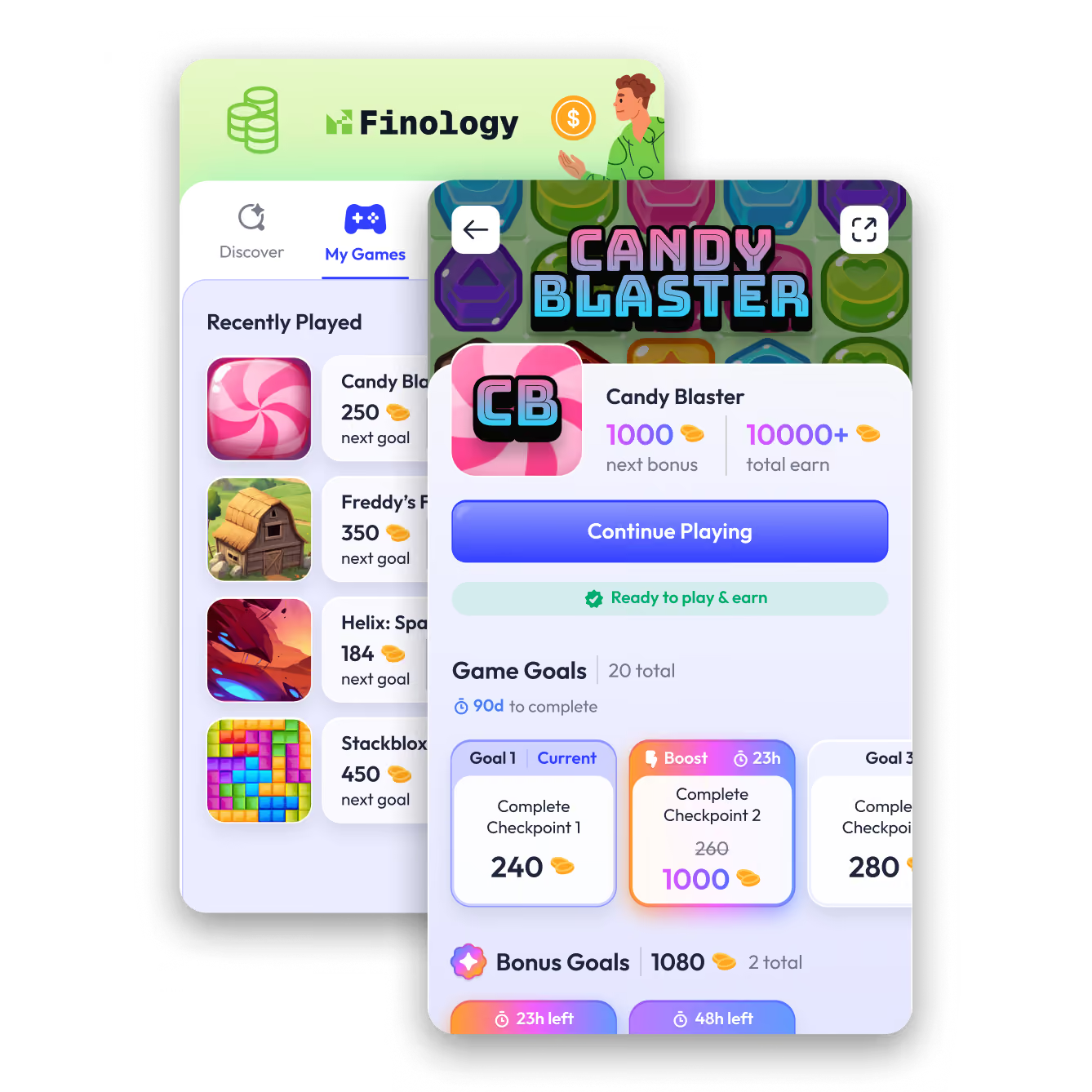
customers buy something from a featured brand, they get cashback. However, there’s another type of reward that relies on earning the reward, instead of getting it from a purchase.
It’s game-linked rewards. Your customers interact with a gaming hub inside your app, play a game, and they get rewarded for the time they spend playing. So, if card-linked rewards require money to unlock, game-linked rewards just require your customers to invest some time.
Game-linked rewards have been around for a while, but recently they’re making their way into the fintech industry. Even though it may seem that there’s nothing in common between finance and gaming, these features work better together than you imagine.
In our previous article about fintech gamification, we found that 43% of marketers see gamification as an essential feature to build brand loyalty. Game-linked rewards are a way to take this further, by adding a habit that your customers already have as a feature in your ecosystem. In fact, 67% of US adults play mobile games weekly.
And the performance impact this new type of reward has is striking. For example, after integrating game-linked rewards into their app, Klink Finance saw a steep +200% increase in ARPDAU, followed by a +35% increase in incremental revenue.
If you’re ready to try game-linked rewards, then LoyaltyPlay may be the right platform for you. It’s Mistplay’s rewarded gaming hub, and it provides your customers with a curated catalog of mobile games that they can pick from to earn rewards through playtime.
Just like regular card-linked rewards, Mistplay funds each reward, so your budget stays untouched, and you can reinvest your share of revenue directly back into your loyalty program.
Curious to see how LoyaltyPlay can help boost your loyalty program? Reach out to us to get started.