

EN
.avif)
app-publishers
Everything comes with a cultural connotation, and rewarded advertising is no exception.
If you want to launch a rewarded ad campaign, you must first have an idea of what resonates with your audience and what “rewards” look like to them – and that can change from country to country.
To find out, we went straight to the source, Mistplay's own rewarded advertising experts on the ground in Japan, South Korea, China, Europe, and North America:
Here's what they told us about how rewarded ads are perceived in their markets – and what it means for your next campaign.
👀 Related reading: Global growth, local play: Mobile gaming behavior & trends across the US, UK, Korea, and Japan
🇯🇵 Tetsu, Japan: In Japan, rewarded advertising is already deeply integrated into the Poikatsu culture, the practice of earning points and rewards through everyday activities. Users are generally familiar with engaging with ads in exchange for rewards, so the format feels quite natural.
🇰🇷 Josh, South Korea: In Korea, rewarded advertising is no longer really perceived as advertising. It's seen as part of 앱테크 (app-based investing), where users voluntarily earn small rewards through apps as a form of micro-income. Users respond positively as long as the reward is clear, fast, and actually usable.
.avif)
🇨🇳 Eric, China: In China, traditional Western-style offerwalls have virtually disappeared due to strict restrictions and ongoing anti-fraud battles. Instead, rewarded advertising has evolved into native "task centers" and content-unlock mechanics (such as "Lite" apps, WeChat Mini-Games, and Mini-Programs). Chinese users view this as part of the "micro-earning economy", naturally trading time for cash or perks.
🇪🇺Stephen, Europe: It's matured a lot, but it's still catching up to other regions. The lingering scepticism that came from the old "incent traffic" era – when incentivised installs meant bot farms and inflated numbers – has died. Still, UA teams tend to be more measurement-conservative and ROAS-disciplined.
🌎 Navi, North America: Rewarded advertising has come a long way in the North American market. The old notion of incentivized traffic that equals bad quality has mostly disappeared. Advertisers are often looking to diversify their media mix, and rewarded advertising has become a meaningful portion of the mix. Users are often going to rewarded apps as a discovery engine, leading them to download and engage with games they may not have seen before.
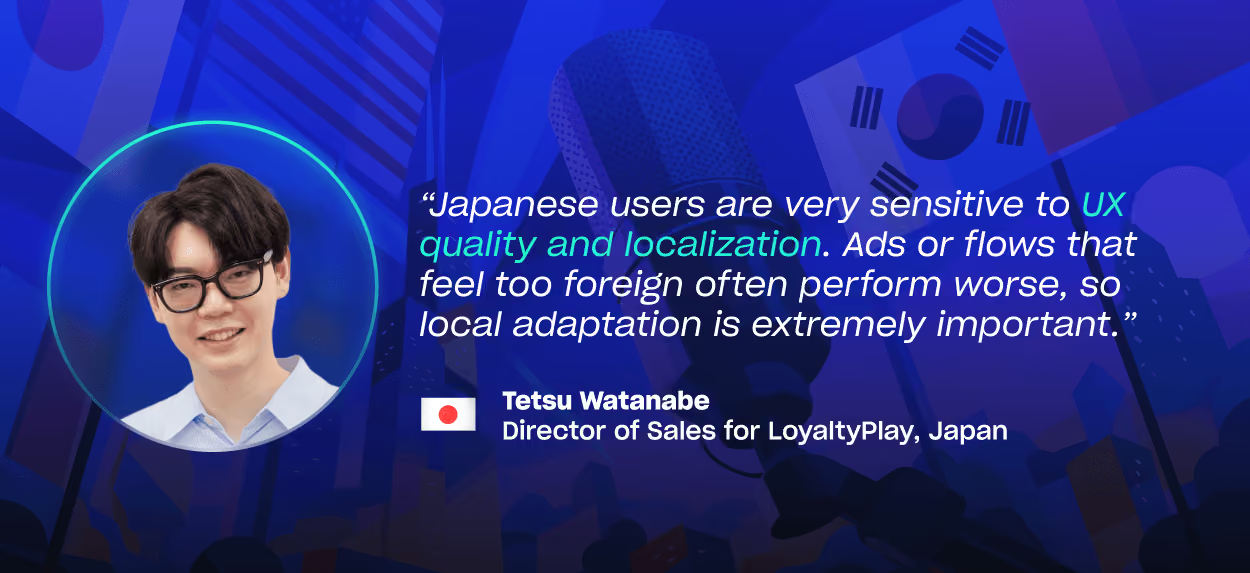
🇯🇵 Tetsu, Japan: The strong Poikatsu culture makes rewarded advertising more effective by default. The main challenge is UX sensitivity. If something feels too foreign or is poorly localized, Japanese users disengage quickly. So, local adaptation becomes essential.
🇰🇷 Josh, South Korea: Korea is a strong market for rewarded advertising. Users are already accustomed to points, coupons, cashback, app missions, attendance checks, and walking rewards. The mindset that helps most is the "small but certain benefit" logic: users will collect small rewards consistently as long as they feel the value adds up over time.
🇨🇳 Eric, China: The biggest cultural driver is the prevalent "薅羊毛" (frugal/task-seeking) mindset: users are eager to perform tasks for tangible rewards. However, the local challenge was overcoming OS/ecosystem restrictions and scripted bot farms, which killed simple install-based offerwalls and forced the adoption of deep-funnel CPE (cost per event) models.
🇪🇺Stephen, Europe: Europe isn't one market but forty, so a rewarded strategy needs to be rebuilt per country: language, payments, and ARPU all differ. Europeans also have a deep loyalty culture, so they intuitively trust earning points for engagement – as long as the value exchange is crystal clear, since users are more privacy-conscious and won't participate in anything that looks too good to be true
🌎 Navi, North America: Some of the best quality users in rewarded advertising come from the US market. Couponing and rewards-based purchasing continues to grow in the US, so having a variety of ways that you can earn while interacting with games is an added bonus for the US market.
🇯🇵 Tetsu, Japan: Engagement is driven by perceived value. Rewards with upside potential, such as stocks, gold, or lottery-style mechanics, tend to generate stronger engagement because users feel the reward could grow into something more valuable over time.
🇰🇷 Josh, South Korea: Korean users engage to earn points, cash, coupons, gift cards, or app currency they can actually use. The motivation is practical rather than entertainment-driven.
🇨🇳 Eric, China: Motivation is driven by instant, practical value. Chinese users have zero patience for abstract points that take months to redeem; they demand immediate micro-cash payouts (via WeChat Pay or Alipay), instant unlocks for short-drama episodes, or critical in-game boosts.
🇪🇺Stephen, Europe: Not just the money. The reward is a permission structure, not the whole motivation. It gives users a reason to try a game, and the good ones keep playing because they like it. Cost-of-living pressure has made "getting something back for time I was spending anyway" more appealing, and we see that in redemption behaviour. But the users who actually retain and monetise are ultimately motivated by discovery and progression.
🌎 Navi, North America: Perceived value is very important to users in the US. Clear instructions on what needs to be done, how the user needs to progress within a game, and what reward will be received are key for a campaign to be successful.
.avif)
🇯🇵 Tetsu, Japan: Poikatsu apps are the natural fit, since users are already looking for rewards. Manga apps also work well: users who engage with a specific IP are more likely to convert into users for related games. For example, a Dragon Ball manga reader who downloads a Dragon Ball game.
🇰🇷 Josh, South Korea: The strongest examples in Korea come from outside gaming. Finance and payment apps like Toss and KakaoPay have integrated rewarded mechanics that feel like a natural extension of the product. Naver Webtoon is another strong case: users complete missions to earn cookies that unlock paid content they're already motivated to access.
🇨🇳 Eric, China: Domestically, "Lite" apps (Douyin/Kuaishou Lite), WeChat Mini-Games, and short-drama platforms (like HongGuo) lead the way by turning task rewards into core product features. Internationally, Chinese publishers are dominating global UA and monetization through the Merge genre.
🇪🇺Stephen, Europe: Anything with depth and a real progression curve, for example casual puzzle and match-3, social casino, mid-core RPG and 4X strategy. These share early milestones users can hit in the first sessions, which lets us align the incentive with something the advertiser actually values. It works less well for shallow, short-lifespan hypercasual titles.
🌎 Navi, North America: Puzzle, match-3, merge, and social casino genres tend to work very well for rewarded advertising. These games often have models that capture user attention early, then engage that user in meaningful ways to encourage them to progress through the game.
🇯🇵 Tetsu, Japan: Lottery-style rewards and rewards with upside potential, like stocks, gold, or similar mechanics. Gamified rewards also perform well, like systems where users watch ads to collect resources needed to grow a character, pet, or plant.
🇰🇷 Josh, South Korea: Cash or bank-transferable rewards are the strongest format. Payment app points work well because users already know where to spend them, as well as coupons and gift cards for coffee, convenience stores, and food delivery. In-game currency still works in gaming contexts but is less effective compared to the real-world formats.
🇨🇳 Eric, China: Direct cash micro-transfers to digital wallets (WeChat Pay/Alipay) are the undisputed king in China, followed by immediate content unlocks (such as short-drama viewing passes) and high-utility in-game items. Abstract loyalty points or hard-to-redeem gift cards are generally ineffective.
🇪🇺Stephen, Europe: Across Europe, gift cards do the heavy lifting. Amazon is the near-universal default, alongside Google Play and App Store credit, PayPal, and crypto.
🌎 Navi, North America: Gift cards and cash back are the most successful reward types. Oftentimes, many users earn their units to get a gift card to Amazon, Walmart, and similar, or simply get cash back through PayPal.
🇯🇵 Tetsu, Japan: Japanese advertisers have historically treated rewarded advertising as a last resort rather than a core UA strategy. That perception is shifting as the format becomes a global standard, and demand has been growing steadily. However, some advertisers may still need guidance when running campaigns in Japan.
🇰🇷 Josh, South Korea: Publishers see rewarded ads as both a monetization and retention tool. Advertisers treat it as performance marketing, paying for real actions like installs, sign-ups, purchases, and account openings.
🇨🇳 Eric, China: Local advertisers view legacy offerwalls as obsolete and high-risk. Instead, they embrace deep CPE (Cost Per Event) formats and IAA+IAP hybrid monetization. Advertisers no longer pay for cheap installs, but they pay for deep engagement, such as hitting level milestones, binding an account, or completing a tutorial.
.avif)
🇪🇺Stephen, Europe: EMEA advertisers now treat it as a standalone channel, and rewarded has grown into its own space.
🌎 Navi, North America:Rewarded has become an important part of the media mix for many advertisers. While the scale of social, search, or SDK channels has a much larger scale than rewarded, the quality of high-spending, high-intent users that rewarded can provide is key for many advertisers.
🇯🇵 Tetsu, Japan: Rewarded ads can meaningfully reduce CPI, and with the right optimization, hitting KPI targets can be more achievable than with traditional formats. However, performance depends heavily on how well the campaign is structured and how locally adapted the experience is.
🇰🇷 Josh, South Korea: Rewarded ads are effective for driving immediate user action, and volume can come quickly. But volume alone isn't enough. Campaign quality depends on how deeply conversion events are set and whether users engage even after collecting their reward. DSP campaigns are stronger for targeting and discovery, but user intent there tends to be more passive.
🇨🇳 Eric, China: By using multi-step reward ladders (for example, rewarding users progressively at Day 1, Day 3, and Day 7) and native in-app task hubs, the evolved rewarded format solves the classic "install-and-churn" problem. Globally, Chinese developers have proven that rewarded advertising is a critical tool for media mix diversification.
🇪🇺 Stephen, Europe: It performs differently, and that's the point. Expect strong engagement and event-completion rates, an early retention curve that looks different from other channels, and payer conversion that often beats expectations. It's not going to be your top-of-funnel volume engine, but it's excellent at surfacing users the algorithmic networks have stopped finding. My honest take: don't judge rewarded on whether it beats AppLovin on CPI – judge it on what your ROAS looks like with it in the mix versus without it.
.avif)
🌎 Navi, North America: It is an important channel to diversify a media mix. The reward curve is different than other non-rewarded channels, but encouraging users to get to certain sticky points within a game has proven to drive strong payer conversion.
Rewarded advertising works across all five markets, but it doesn't work the same way in all of them. The format succeeds when it fits naturally into what users already do, so it’s important to adapt both reward type and campaign structure. A rewarded ad campaign that isn’t structured properly and doesn’t take into account these differences is likely to fail.
At Mistplay, our team helps studios and publishers from all over the world structure their campaigns in a way that feels natural for the target audience. If you’re looking for guidance or would like to know how to adapt your campaigns to cultural differences, reach out to us.