

EN
November 5, 2026
Get a monthly loot box of insights straight to your email!
Subscribe
game-advertisers
Last updated: November 4, 2026
In the past couple years, the share of UA budget that goes towards rewarded UA channels has increasingly grown for game publishers, and in 2027 it’s likely going to accelerate.
But which rewarded UA platform is the best one, and which ones should you have in your media mix for maximum scale and ROAS?
The best rewarded user acquisition (UA) platform for your game depends on a few factors – such as the inventory type, diversity of users, and the reward model you want. For example, if user quality is your priority, O&O rewards apps are often the best platforms for mobile game user acquisition quality, since you can evaluate the community itself. If you need scale, it might be best to select a network-focused platform.
Below, we cover the 9 leading rewarded UA platforms in gaming today in order for you to select the best partners for your growth strategy.
👀 Related reading: What is rewarded advertising and why does it work?
The inventory offered by rewarded UA platforms falls into three groups, based on where players see your game and how they earn.
When evaluating the top user acquisition platforms for games, there are six key criteria we considered for each of these rewarded platforms that cover breadth, maturity, flexibility, and more of each rewarded platform.
Disclaimer: This list is published by Mistplay, and Mistplay is included. Every other mobile game user acquisition platform is described using its own published information or independent data, and each entry highlights both strengths and weaknesses, including ours. Platforms are listed in no specific order of rank.
All third-party names, trademarks, and brands mentioned in this article are the property of their respective owners and are used here solely for identification and descriptive purposes. Their use does not imply any affiliation with, or endorsement by, those owners.
The information in this article is accurate as of November 4th, 2026 based on publicly available data. Mistplay is not responsible for the accuracy of third-party information.
This article is published by Mistplay and reflects Mistplay's views based on publicly available information as of the date last updated.
If you’re looking for high-quality, loyal players from a dedicated O&O rewards community, the app itself is worth evaluating. In the table below, we compare the O&O rewards apps by general community sentiment and stickiness, scored through store rating and daily engagement metrics.
Overall, Tyr Rewards and Mistplay present strong app stickiness with highly-ranking store ratings and daily engagement from their community.
The information in this article is accurate as of November 4th, 2026 based on publicly available data through Sensor Tower. Mistplay is not responsible for the accuracy of third-party information.
Sessions and minutes as app engagement metrics tell you different things about a player community’s engagement.
Founded in 2015, Mistplay has run its own play-and-earn app since 2016, with more than 50 million installs to date, with a strong footprint in key markets in NA, EMEA, and APAC. As of 2026, Mistplay has access to 42M+ monthly active users ready to play and earn rewards, and the platform placed #10 on the Android index of the AppsFlyer Performance Index 2025. Players use Mistplay specifically to discover new games, earn more from the games they already love, and build community with other players through social and engagement features. In 2026, Mistplay unveiled the Mistplay Audience Network, which brought that same pioneering rewarded model to users across various app categories.
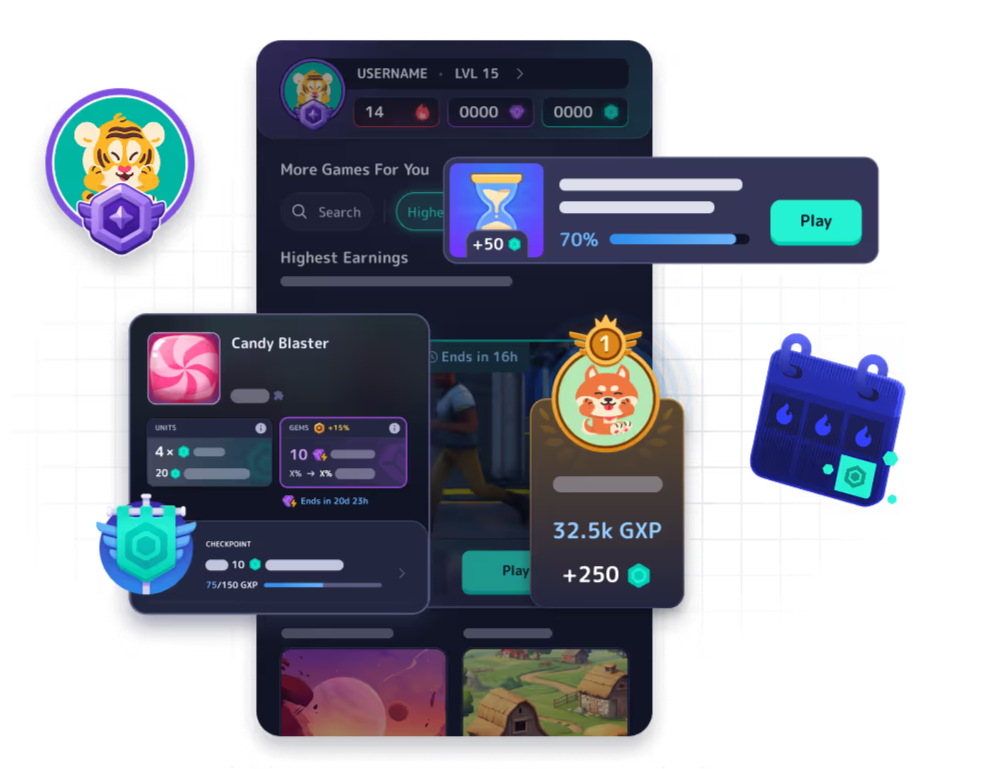
Mistplay O&O is available on Android and iOS, boasting a highly loyal player community, with players coming back for over 7 sessions a day on average, the most of any O&O rewards app we compared. With Playtime Events, Mistplay builds custom reward paths that combine playtime checkpoints with in-game milestones you choose, so players have a reason to keep returning to your game and progressing toward the actions that drive revenue. In testing, Playtime Events lifted average playtime per game by up to 30% and D30 ROAS by up to 20%. Target return on ad spend (tROAS) campaigns use Mistplay's first-party data to bid toward the players most likely to generate revenue.
The Mistplay Audience Network extends the same campaign to 40M+ monthly active users across partner apps in finance, shopping, restaurants, fuel, and convenience, for 42M+ monthly active users in total. One unified campaign manages distribution, optimization, and pricing across the network, with source-level bidding available when you want more control.
Honest limitation: Mistplay's O&O apps are live in 9 high-value markets rather than globally, as the company focuses on depth of presence in each market over breadth. The Mistplay Audience Network extends reach into regions the O&O apps don't yet cover, including a strong footprint in Asia-Pacific (APAC), and the O&O footprint continues to expand.
Best for: Game advertisers that want high-intent players from an owned rewards community, plus incremental reach into audiences outside gaming-only rewards inventory.
👀 Related reading: Announcing the Mistplay Audience Network to drive scale for games and loyalty for brands
AdAction has run performance-based UA since 2013 and reaches users in 180+ countries across iOS, Android, and web. Its acquisition product, Qualume, is built around paying for verified outcomes, such as installs, registrations, completed levels, or first deposits. Supply comes mainly from a curated network of publisher partners alongside some owned inventory, and it spans both gaming and non-gaming apps. AdAction has a Trustpilot score of 3.9 reports 6M+ monthly conversions and placed #17 on the iOS index of the AppsFlyer Performance Index 2025.
Honest limitation: Because supply is network-led, there's no single consumer app to evaluate for user quality or engagement behaviors. Ask for source-level reporting so you can see which placements drive your results.
Best for: Advertisers who want to pay only for verified downstream actions across a broad mix of apps.
Founded in Hamburg in 2018, adjoe runs Playtime, a rewarded format that pays players in-app currency for the time they spend in advertised games and for events they complete. Playtime sits inside publisher apps through adjoe's software development kit (SDK), and that supply includes non-gaming apps, such as the LINE POINTS ecosystem in Taiwan. adjoe cites 200M+ Playtime users and uses machine learning to match players with games they're likely to enjoy. It placed #6 on the iOS index and #12 on the Android index of the AppsFlyer Performance Index 2025.
Honest limitation: The player experience depends on each host app, since Playtime sits inside other publishers' products rather than one owned community.
Best for: Advertisers who want playtime-based rewards at the largest scale, especially on iOS.
Founded in Hamburg in 2015 and now part of the Aonic group, exmox designs multi-reward funnels that pay players at several points in your game rather than once. It combines its own rewards apps, including empfohlen.de and TesterUp, with a network of publishing partners, claiming to reach 250M+ users per month across 180 countries. exmox placed #8 on the Android index and #10 on the iOS index of the AppsFlyer Performance Index 2025, and placed highest on Android among the platforms here.
Honest limitation: Results depend on how well the reward steps match your game's progression, so plan time to design the funnel with their team. Its O&O apps average fewer daily sessions (2.97) than most apps we measured.
Best for: Studios with deep progression systems that want rewards spread across the player journey.
Freecash is the flagship rewards platform of Berlin-based Almedia, founded in 2020. Players earn by hitting in-game milestones, with additional earning opportunities through app tests, surveys, and cashback offers. Almedia reports that 9M+ people earn on Freecash each month, with rewards paid out in 217 regions. Freecash placed #11 on the Android index and #15 on the iOS index of the AppsFlyer Performance Index 2025, and its app logs 4.1 minutes of use per player each day, among the highest we measured.
Honest limitation: Games share the app with surveys and cashback offers, so your title competes with other offer types for player attention. Players also open the app less frequently than on most reward platforms we measured (1.95 sessions a day).
Best for: Advertisers who want large volumes of players working toward clearly defined in-game milestones.
Founded in Germany in 2022, Gamelight is the youngest platform on this list. The company runs seven self-published rewards apps and uses an AI algorithm to match players with games based on their playtime, engagement, and behavior. Players earn for active playtime, and advertisers manage campaigns through a self-serve dashboard. Gamelight placed #9 on the Android index of the AppsFlyer Performance Index 2025.
Honest limitation: Gamelight doesn't publish a user count, which makes its reach hard to size against other platforms, and we couldn't measure engagement for its apps.
Best for: Teams that want playtime-based rewards with hands-on, self-serve campaign control.
Prodege launched Swagbucks in 2008 and also runs rewards brands such as MyPoints and InboxDollars. It promotes partner games across its apps and websites on a performance basis, with Swagbucks itself seeing 2M+ monthly active users according to Sensor Tower in October 2026. Members earn through games alongside surveys, shopping, and other offers. On Swagbucks, players average 2.78 sessions and 2.1 minutes a day.
Honest limitation: Games compete with surveys and shopping for member time, since Swagbucks is a multi-category rewards platform.
Best for: Advertisers who want to reach a large, long-standing rewards membership that already earns across many categories.
Influence Mobile was founded in 2012 and launched Rewarded Play in 2019. Players earn points for hitting achievement milestones in partner games, such as reaching a level or making a purchase, and redeem them for gift cards. The app has positive community sentiment with a 4.2 rating from 240K+ reviews on Google Play and players averaging 4.46 sessions a day – third highest among the apps we measured.
Honest limitation: Rewarded Play has historically been Android-first and North America-focused. While its FAQ now also lists iOS and the UK and Australia, advertisers should confirm current availability and quality for your target markets.
Best for: Advertisers focused on North American Android players who want achievement-based rewards.
Founded in 2018 and headquartered in Singapore, TyrAds combines its own Tyr Rewards app with an offerwall network that publishers integrate through its SDK. Rewards span playtime, achievements, and daily tasks, and TyrAds reports 50M+ monthly active users, with clients including Scopely, NetEase, and Huuuge Games. Tyr Rewards shows strong engagement: 6.29 sessions and 4.54 minutes per player each day, second only to Mistplay on sessions. TyrAds placed #22 on the Android index of the AppsFlyer Performance Index 2025.
Honest limitation: The Tyr Rewards app also features surveys, so ask how much of your traffic comes from gaming-focused players and request geo-level reach breakdowns.
Best for: Studios that want progression-based rewards with a strong presence in APAC.
When you’re looking to add more rewarded channels to your media mix, start with your retention goal and work back to the platform. These five checks will help narrow your list so you can begin testing:
The strongest rewarded UA mix usually pairs one O&O channel for player quality with one network or hybrid channel for reach, then shifts budget toward whichever hits your ROAS targets. Still unsure of where to focus? Here are the questions we hear most often from UA teams weighing their options.
What is rewarded user acquisition? Rewarded UA is a model where players install and engage with your game in exchange for a reward, such as points redeemable for gift cards or in-app currency. Because players opt in and enter a clear value exchange, rewarded UA tends to bring in players with a clear reason to keep playing. Read more →
What's the difference between playtime-based and event-based rewards? Playtime-based rewards offer points to players for the time they spend in your game, whereas event-based rewards offer points when players hit milestones you define, such as reaching a level or making a purchase. Some platforms, like Mistplay, offer both playtime and event-based rewards for a hybrid approach to building your game’s reward path.
Is rewarded UA traffic good quality? It can be, especially when rewards are tied to meaningful engagement. Judge the platform’s user quality by D7 and D30 retention and ROAS by source, and compare rewarded cohorts against your other channels over the same window.
How much budget do you need to test a rewarded UA platform? Budgets are usually set per campaign, and while few platforms publish minimums, you’ll want to allocate a decent budget to properly test and evaluate the quality of users and measure the ROAS. When selecting a new partner or platform, plan a test of about four weeks so bidding has time to optimize and you can judge D30 results fairly.
Mistplay has been matching high-intent players with games across genres for over a decade, driving results like 2.5x higher D7 ROAS on iOS for BitMango, and 76% install-to-spender conversion growth for Playrix on Android.
If you’re looking to expand your UA into new markets and access high-quality, loyalty users in 2027, check out our play-and-earn rewarded UA platform and reach out to us today to get started.