

EN
October 29, 2026

brands-retailers
One of the biggest challenges of running a retail business today is to engage customers between transactions: your customers visit your store when they need to buy something, but go dormant in between visits.
However, regaining some of that engagement can make a difference for your activity, since it can lead to more frequent visits and sales, and larger baskets. So, how do you make sure that your engagement strategy works?
In this article, we go over some real-life examples of customer engagement strategies in retail that brought results to the retail businesses that implemented them, with tips and ideas that you can use for your brand as well.
👀 Looking for a way to boost your engagement? Take a look at LoyaltyPlay for retail.
A customer engagement strategy is a framework that outlines how a brand will interact with its audience at every stage of the customer lifecycle, from initial discovery to post-purchase support.
While customer acquisition focuses on driving transactions, an engagement strategy is designed to build an ongoing relationship that maximizes Customer Lifetime Value (LTV) and brand loyalty.
An effective customer engagement strategy sits on a few core pillars:
Customer engagement in retail is important because it’s tied to revenue: the more your customers engage with your brand, the more likely they are to buy something from you. In fact, customers are willing to pay 5% more, and to shop again at the same place if a brand offers a positive shopping experience.1
However, today, customer engagement walks a delicate balance, because brand loyalty is thinner than ever: 60% of customers admit not to pay attention to brands, and actually 67% of them switch to a cheaper brand when available2. Moreover, for 52% of customers, one bad shopping experience is enough not to interact with that brand again3.

In its Global Engagement Index1, SAP uses an interesting term: the “Engagement Divide,” referring to the distance between what customers need and what brands can offer.
Going through their research, it’s striking to note that customers and brands seem to travel on two separate tracks. For example:
To better understand how the right customer engagement strategy can make a difference for your brand, let’s go over some real-life examples where brands succeeded in turning customer engagement into tangible results – and what tips you can gather from them.
Transactional moments are high-engagement moments by definition, because people are ready to buy from you. Pairing this interest with a discovery engine cannot only increase engagement, but also the basket size.
For example, 24S is a luxury fashion e-commerce platform that turned its “[Item] is back in stock!” email into a whole engine of discovery and sales.
When an out-of-stock item returned, the alert was bundled with four AI-selected product recommendations based on the user's specific browsing history. According to Braze, this approach resulted in a +7% increase in add-to-cart rates.4
If your customers have already set an alert to know when your products are available, this means that they’re ready to purchase – and likely do it immediately after getting the email. Pairing this interest with related suggestions can increase engagement with your brand, because customers will browse through suggested items, and also increase the chances of a bigger cart.
Other transactional moments you can turn into discovery moments include:
Last year, Sephora launched a new filter on TikTok, which allows people to spell their name using their favourite Sephora product. The filter was a huge success, and the original TikTok video that launched it totalled 208K engagements.5
This is a perfect example of interactive content: you don’t just show your customers something, but you actually make them interact with it. You can apply this strategy in many different ways, for example, through quizzes, mini-games, or social media contests.
Today, people are flooded with content, and most of it goes unnoticed. However, giving your customers something to interact with – whether it is a filter or a quiz – can increase their engagement with your brand in between purchases and turn that engagement into future sales.
You can apply this strategy in many ways, such as:
Personalizing the experience and the offers to your customers’ likes has become a key strategy to stand out, and customers expect it as well. In fact, 37% of consumers feel disappointed that brands don’t personalize content to their needs.3
Sally Beauty, an international retailer of beauty products, used first-party data, such as in-app behavior, shipping preferences, and purchase thresholds, to segment customers and send targeted offers in its app. According to Airship, active users grew 7% year over year, and the app’s share of total e-commerce revenue rose from 12% to 22%.6
You probably already collect more data than you use. Preferences let you send each customer something relevant, instead of the same message to everyone. For example:
If you want an even more accurate picture, you can also ask customers directly, through quizzes or preference settings (zero-party data).
A customer engagement strategy isn’t effective if it isn’t paired with strong customer support. As mentioned above, one bad shopping experience is enough for a lot of people not to interact with a brand again, and customer support plays a big part in this.
One great example of how customer support can turn into an engagement strategy is Chewy, the e-commerce store for pet supplies. Chewy’s support is known for sending spontaneous gifts to customers, as well as for its empathetic refund policies (Chewy refunds unopened pet food, encourages customers to donate it to shelters, and sends handwritten condolence cards and flowers).
These gestures turned their customer experience into an organic marketing channel, and through spontaneous social media posts and word-of-mouth, Chewy established itself as one of the biggest e-commerce companies in the sector.7
A bad customer support experience puts off customers, while good customer support can become one of your biggest strengths. A good experience with your support can translate into positive reviews, word-of-mouth, and organic recommendations, which are a valuable marketing channel.
For example, you can:
Loyalty programs in retail are popular, but most of them are tied to purchases, so you issue rewards when people buy something from you. Gamifying your rewards means giving customers additional ways to earn that don’t depend on spending.
For example:
If you want to go further, you can bring in actual mobile games. KAUCHE, a social commerce Japanese app, added LoyaltyPlay, Mistplay’s rewarded gaming hub, so users could earn rewards through game missions. The first month of the campaign delivered the highest revenue to date.
Games give customers a reason to open your app that has nothing to do with spending, which keeps your brand present between purchases without adding pressure to buy. Rewarded gaming takes this even further, because your shopping app becomes a place for discovering new games, rather than just shopping.
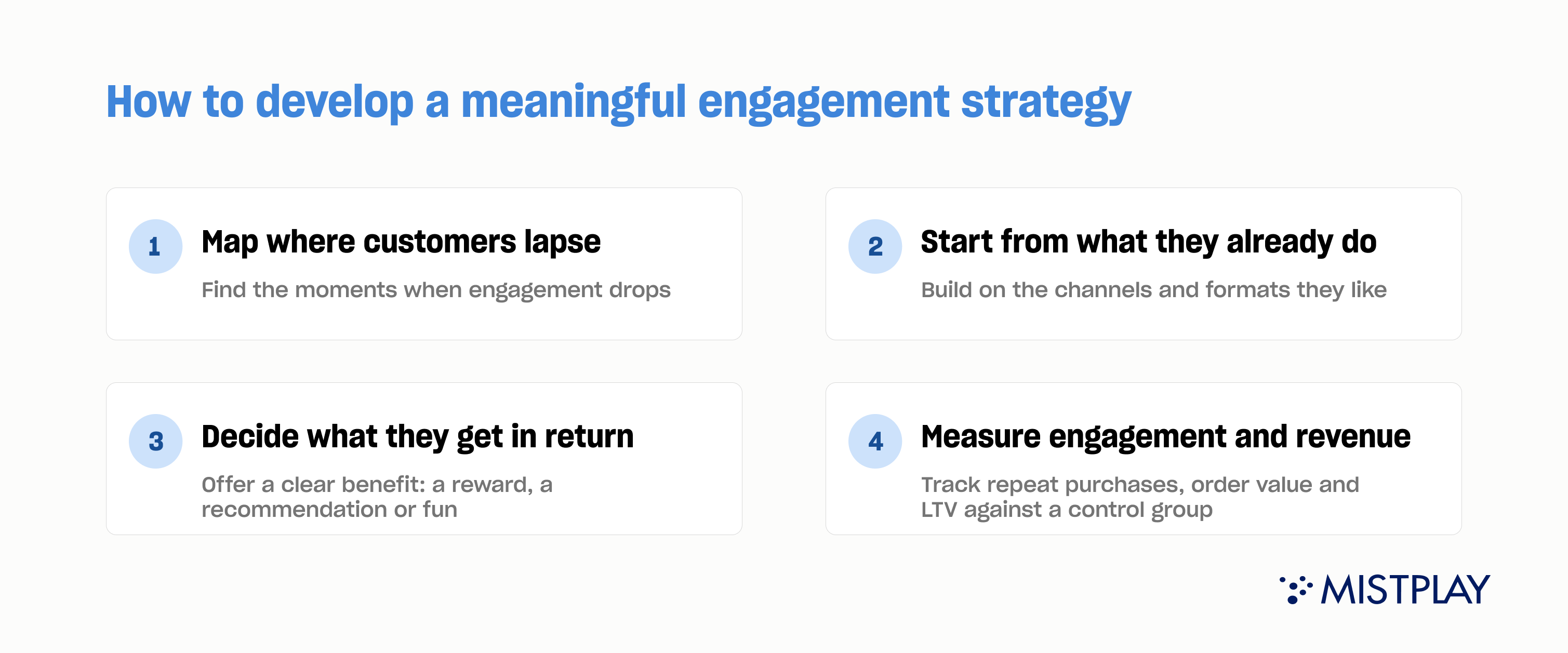
The examples above come from very different brands, but the way they got there has a lot in common: they started from a specific gap in their customer relationship and picked the tools that would fill it. If you’re building your own strategy, these steps can help you do the same.
👀 Read also: From ideas to implementation: How to create a successful loyalty program
Engaging customers between purchases comes down to giving them a reason to come back when they have nothing to buy, whether that’s through personalized offers, interactive content, or rewarded play.
Gamified rewards are a direct way to do that, because they give customers a reason to open your app that doesn’t depend on spending. That’s what Mistplay’s LoyaltyPlay was built for. It’s a rewarded gaming hub where your customers discover and play mobile games and earn your own rewards, adding a fun way to stay connected to your brand between purchases.
Want to see how it could fit your retail business? Get in touch with us, and we’ll walk you through it.
Sources: