

EN
September 28, 2026
5 examples of fintech customer engagement strategies
Get a monthly loot box of insights straight to your email!
Subscribe.png)
app-publishers
In 2003, Bain & Company analyzed the state of banks and found that a 5% increase in customer retention could result in a 25% increase in profit1. Loyal relationships – they argued – are the first driver of profitability in finance.
Today, more than 20 years later, this study is still cited across various industries, and it’s still very relevant. According to First Page Sage2, fintech companies have among the highest customer acquisition costs of any industry: from an average of $202 for consumer-facing companies, to an average of $14,772 for enterprise solutions.
In this article, we take a look at fintech companies that dared to think outside the box and developed customer engagement strategies that paid off. From apps roasting you for your budgeting style to apps that integrated mobile games into their interface, these companies made fintech retention their priority.
👀 The first step to fintech engagement can be gamification. Learn more here: How gamification can turn your fintech app into a daily app
Fintech retention is the ability of a fintech app to keep its users engaged and transacting over time. The term covers a few distinct, but related, things:
Having multiple banking accounts today is the default: Simon-Kucher found that around 72% of consumers have two or more accounts with different providers3. In this scenario, fintech companies face competition from two sides:
Here’s where fintech retention and engagement come in: the longer a user stays with a fintech company, the higher revenue they generate through transactions, subscriptions, or interest.
Since fintech companies can’t win on trust alone, nor on novelty, they need to put their effort into cultivating a relationship with their customers in order to become their first choice.
With such a saturated market, companies need to get creative to stand out. There are companies that really went the extra mile to make sure that their app experience was engaging for their customers.
In this section, you can find five fintech customer retention strategies that stand out for their creativity and results. These strategies are all grounded in real human behaviors and the response to certain triggers, and they come down to some simple concepts:
Let’s take a closer look.
When you think of money, you're likely to associate it with efficiency and practicality. However, money is also a deeply emotional subject – tied up in stress, shame, ambition, and identity in a way that most other utility categories aren't.
Since most fintech apps offer the same tools, giving your app a personality can become a great differentiator. In this way, your customers aren’t choosing your app for what it can do, but for how it makes them feel when using it.
Cleo AI is a budgeting app that makes having a personality its core differentiator.
Instead of showing you graphics and stats of how much money you spent, Cleo AI uses a chatbot that talks to you as a friend. For example, the Hype Me mode is designed to hype you up and encourage you to save money, while the Roast Mode becomes sarcastic and occasionally brutal, mocking you for overspending.

As Katie Locke, Lead User Researcher at Cleo AI, explains4, many people spend money as an emotional response. So, giving budgeting a human voice and personality allows them to laugh at a mistake instead of feeling the shame of not sticking to a budget.
This approach works, since Cleo AI has seen users engage 20x more than they do with typical finance apps.
Have you ever heard about the IKEA effect5? It’s a cognitive bias that leads people to give way more value to products they’ve created.
That same bias is being used with community-led development: developers ask their community what the app needs and then build it from their feedback. This has a positive effect on retention, since users stay because they helped build it.
Monzo is a British digital bank that has made community-led development its foundation right from the start. They opened a community forum when they had a few hundred customers, and today the forum has evolved with their product and their growing user base.
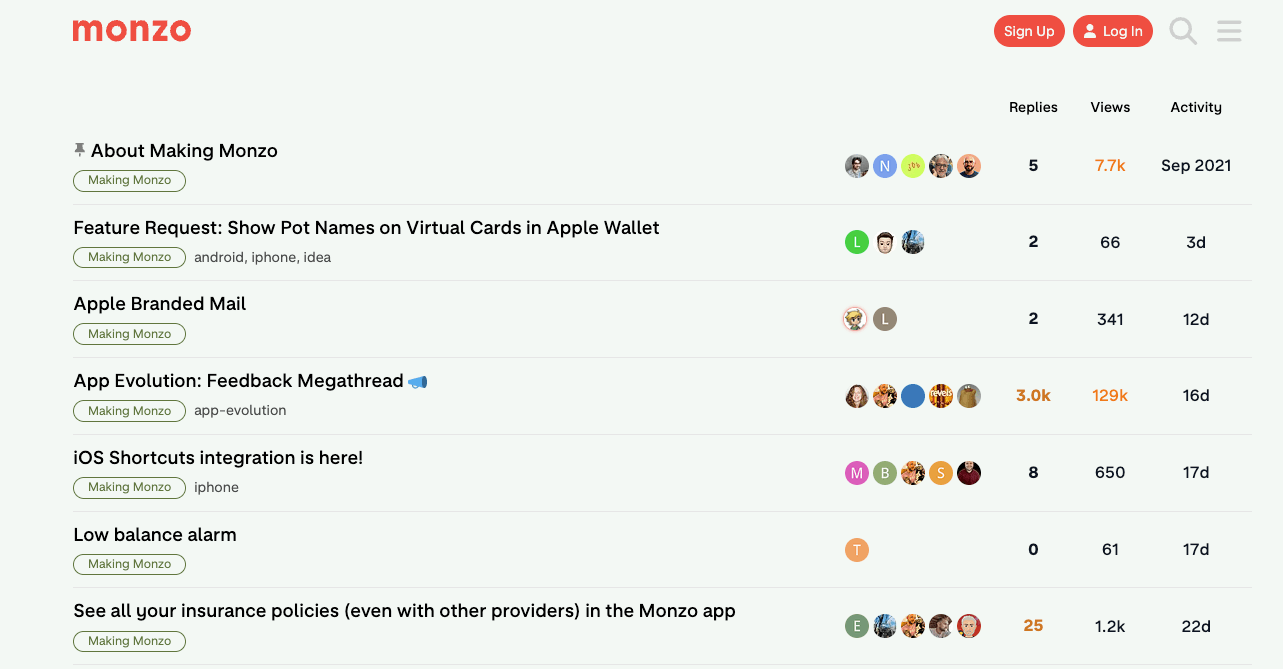
This approach works in two ways:
According to Monzo, around 45% of their user base has engaged with their forum6 at some point, and the forum has become a real driver of loyalty and app engagement.
As mentioned above, money is emotionally loaded – it can come with shame or regret – and this is also why many people find it difficult to stick to a financial plan. A good way to make your fintech app more engaging (and less stressful) is to make the user experience frictionless.
Let’s take saving again as an example. If your customers need to manually transfer their money to a savings account, this will slowly lead to churn, because even a small action can be perceived as tedious when it needs to be repeated often.
There are companies that are taking a different approach. Instead of asking people to build a new habit from scratch, they attach the saving behavior to something customers are already doing.
Qapital is a great example of this approach. The personal finance app integrates with “If This, Then That” rules, which allow Qapital customers to tie their savings to an odd personal trigger. For instance, customers can transfer $2 to their savings account each time they buy coffee, or when they add a track on Spotify.
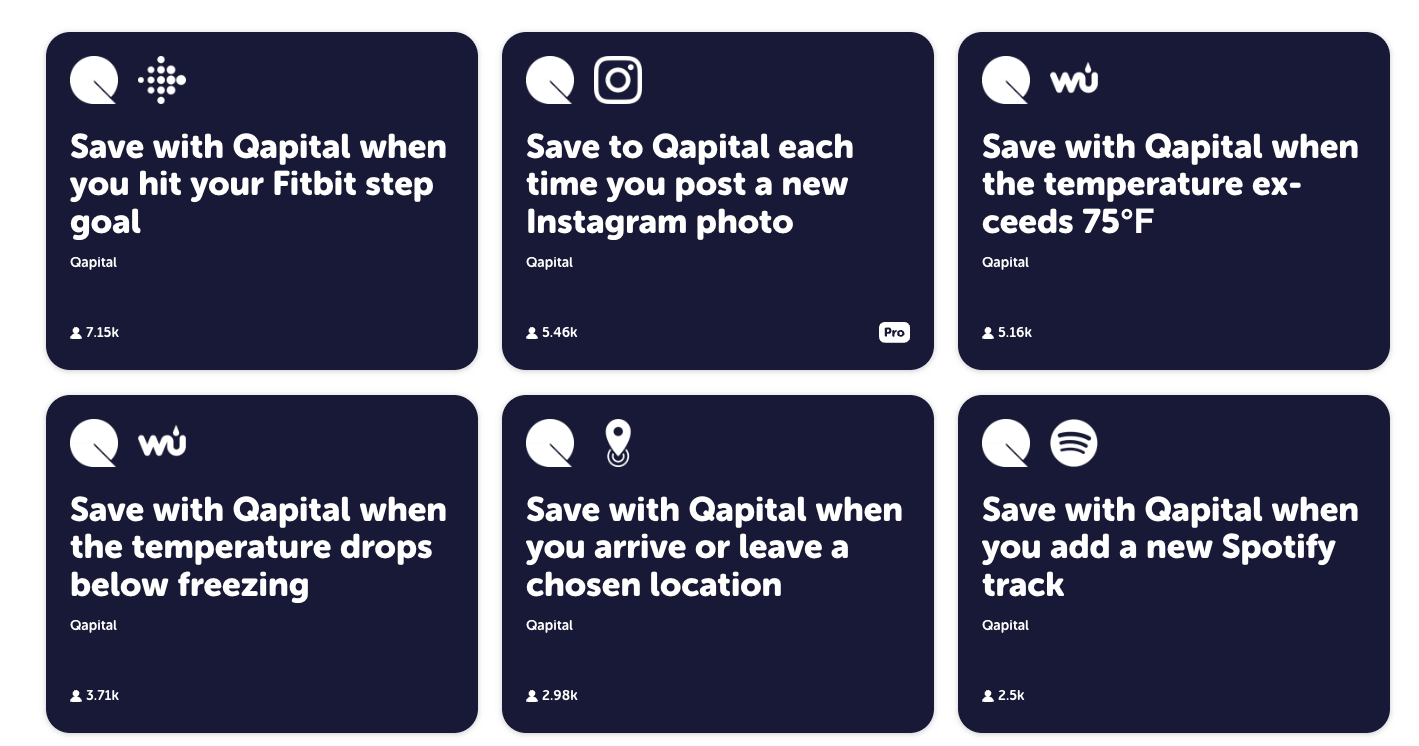
The reason it works is that it removes the moment of decision entirely. Users aren't asked to choose to save every week; the saving just happens as a side effect of their usual habits, which is exactly the kind of low-friction design that helps build a consistent behavior.
Financial progress is usually slow and mostly invisible to the person experiencing it, and this can lead to disengagement in the long run. Adding milestones breaks the progress into small checkpoints and turns the process into an easier quest.
Milestones work great, especially when paired with small celebrations: this gives the user a deeper sense of achievement, and it makes them come back to unlock the next milestone.
Acorns is an investing app best known for rounding up everyday purchases and investing the spare change. The app has integrated milestones as a way to encourage users to achieve their investment goals.
As their former CMO explained in an interview, the company's approach centers on "defining meaningful milestones along the entire customer journey – milestones that reinforce positive behaviors and encourage commitment"7.
The results back up the approach: in 2021, Acorns achieved a monthly retention rate of nearly 99%6, and this is also due to the rewarding of positive behavior.
Loyalty is another great retention lever, and financial institutions know this well. In fact, almost every bank and fintech company has its own loyalty program, where users are rewarded for bringing a friend, achieving a financial goal, or spending a certain amount through a card-linked offer.
However, more and more fintech apps have also started rewarding customers simply for engaging with the app and spending time in it. An example of this is gaming rewards. The app integrates a gaming layer, users discover and play new games directly from the app, and then they get rewarded for the time spent playing.
This naturally brings app engagement up, because users use your app as a discovery channel for new games, and spend more time in it to earn the rewards.
Klink Finance is a platform where users can earn rewards for completing different tasks, and has a strong community of finance enthusiasts. To increase app engagement, the app decided to integrate mobile games into its selection of tasks by adding LoyaltyPlay, Mistplay’s rewarded gaming hub.
The addition not only increased engagement, but it also brought higher revenue: Klink Finance achieved +200% ARPDAU and +35% incremental revenue.
Finance and fintech apps are transactional by nature – users only open them when they need them – so it’s natural that their engagement rate is lower compared to other app categories.
However, the examples highlighted above have something in common: instead of competing on rates, fees, or core functionality, these companies acted on how the overall experience felt for their customers.
With this in mind, here are a few concrete levers worth auditing in your own app:
Every strategy in this article shares the same goal: give users a reason to open your app that isn't tied to a transaction they need to make. That's the hardest gap to close in fintech specifically, because most of what your product does well doesn't need to happen every day.
LoyaltyPlay closes that gap. It's a rewarded gaming hub, built to reduce low engagement between transactions. Instead of asking your team to design and build new gamified features from scratch, LoyaltyPlay layers a play-and-earn experience into your existing app. Users discover new mobile games and earn rewards they can redeem inside your ecosystem, whether that's cashback, points, or credits toward your core product.
The model solves two problems at once:
If you're ready to fill the engagement gap and bring your retention numbers up, gaming rewards are one of the lowest-lift ways to close it, because there’s no new product to build. Get in touch with our team to learn more.
Sources