

EN
Get a monthly loot box of insights straight to your email!
Subscribe.avif)
The Chinese mobile games market is huge and lucrative, but many game devs are perplexed by it. Breaking into this market is not a simple task, as the regulations, culture, and nuances of the market are quite different from many other mobile game markets, but it’s certainly achievable with the right strategy and approach.
If you want to unlock the secrets of mobile games in China, in this article, we will cover everything you need to know about the world’s biggest mobile games market, including its:
👀 Related reading: Global growth, local play: Mobile gaming behavior & trends across the US, UK, Korea, and Japan
Home to 683 Million gamers, China is one of the biggest gaming markets in the world. Not only that, but it keeps growing in terms of both player count and revenue – with the current player count of the country being a +1.35% increase compared to last year (GCores).
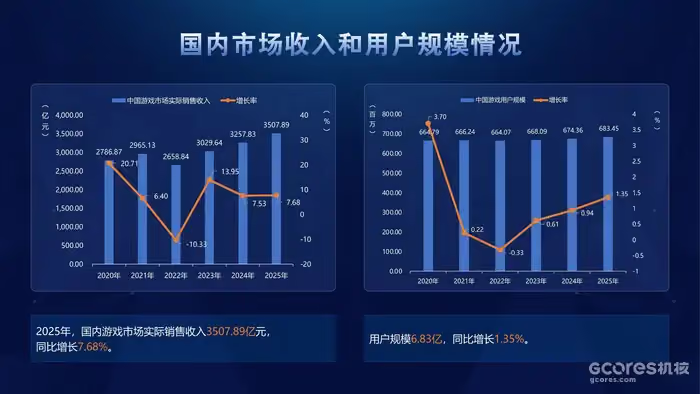
Looking at the first graph, we see that the Chinese gaming market in 2025 was worth 350 billion yuan, which is around 49 billion dollars. In particular, mobile games in China generated around 73% of this total revenue: 257 billion yuan, around 36 billion dollars.
A consistent part of mobile gamers also interact with the so-called “mini-games”. These are mobile games embedded directly into apps like WeChat and Douyin, so users can play a game without leaving the app. The mini-games business has been rising for a few years now, and in 2025, it reached 571 million players on WeChat and 171 million players on Douyin (36 Kr).
Given its size and scope, the Chinese mobile games market undoubtedly deserves the attention of every game developer in the world.
However, China has strict gaming regulations that pose a major challenge for mobile gaming companies. Not only that, but Chinese players have a distinct set of habits and preferences developers need to be aware of.
Because of this, many studios shy away from this market and focus their efforts elsewhere.
But, the companies that take on the challenge of developing games that comply with the rules and preferences stand a great chance of succeeding in this major market.
Here is a list of Chinese gaming regulations you need to be aware of.
To get published in China, all games with payment features (IAPs or Premium) need to obtain a special license. This license is issued by the country’s National Press and Publication Administration (NPPA). To get your game approved, you need to follow different rules set by NPPA. Among other things, this means that your games are not allowed to:
On the other hand, the regulatory body encourages games with educational elements, those that match the government’s social values, historical views, etc.
Due to these strict licensing rules, it’s not surprising that the majority of games that get the license are domestic titles.
The record year for game licensing was 2017, when NPPA issued 9,177 licenses for domestic game developers and 456 for foreign ones. After that, the regulations were further tightened, which significantly lowered the number of issued licenses.
In 2021/2022 things got even more complicated – China introduced a freeze on new game licenses. The freeze lasted for almost nine months, leading to a record-low game license count in 2022. That year, the body issued only 512 licenses, 91% of which were Chinese titles (Niko Partners & NPPA).
In 2025, the situation improved. The NPPA issued 1771 licenses, 1676 for domestic titles and 95 for imported games. An average of 147 games per month (Niko Partners).
If this rate of approval continues, we can expect over 2000 new licenses to be issued by the end of 2026. The trend is clearly positive and creates an encouraging atmosphere for foreign game developers looking to publish their games in China.
To get a game published in China, it’s not enough “just” to follow NPPA’s content rules. Another necessary requirement is to partner with a domestic publisher: only companies with 100% Chinese ownership are eligible for a game license.
However, this still doesn’t place them in the category of domestic publishers.
Even if you manage to get your game published by working with a trusted Chinese publisher, it would still be classified as imported. For example, in China, both Call of Duty: Mobile and FIFA are published by Tencent. But, because their original IPs are foreign, they are considered imported games.
When picking out a local publisher to work with, aim for the big ones like Tencent and NetEase. According to Mintegral, 86% of Chinese players prefer these two publishers over all the others. Working with them is especially helpful for user acquisition, as players are more likely to install a game from a trusted advertiser.
If you want to publish a game that monetizes with ads only, you don’t need an NPPA license. In fact, in-app advertising is becoming increasingly popular in the country and a major monetization strategy for mobile games in China.
According to the NPPA report, the revenue of IAA for mobile casual games in 2025 was 11.6 billion yuan, which is around 1.6 billion dollars. And mini-games earned even more from IAA, around 2.5 billion dollars.
However, you should note that you’ll still need a Chinese publisher to release your game.
Besides game content, China also regulates the amount of time minors can spend playing games. These restrictions were introduced in 2021 with the goal of protecting children from gaming addiction and overspending.
Here are some of the rules Chinese underage gamers need to follow:
All gaming companies are required to identify anyone under the age of 18. In order to play any game, players need to submit their IDs.
What types of genres and subgenres rule the Chinese mobile games market? Which titles are on top of the charts?
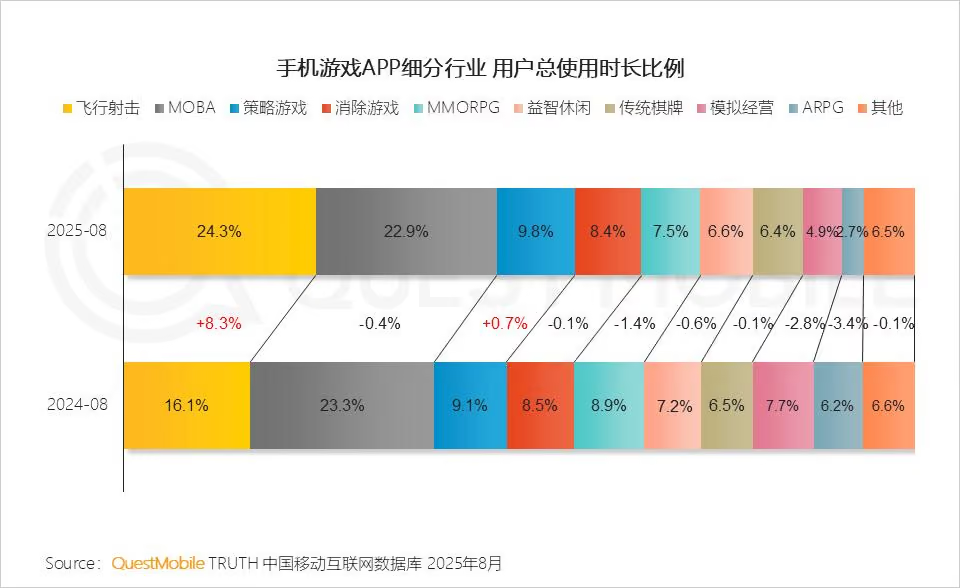
QuestMobile analyzed the mobile game genres with the highest hours of play and found that Chinese gamers’ favorite genres are:
You might be wondering how these typically violent game genres manage to get away with in-game violence. The truth is, the rules on this matter are not as strict as they appear.
For example, displaying a character’s death is acceptable as long as there is no bloodshed. It is recommended that deceased bodies vanish quickly, for instance, by gradually fading away.
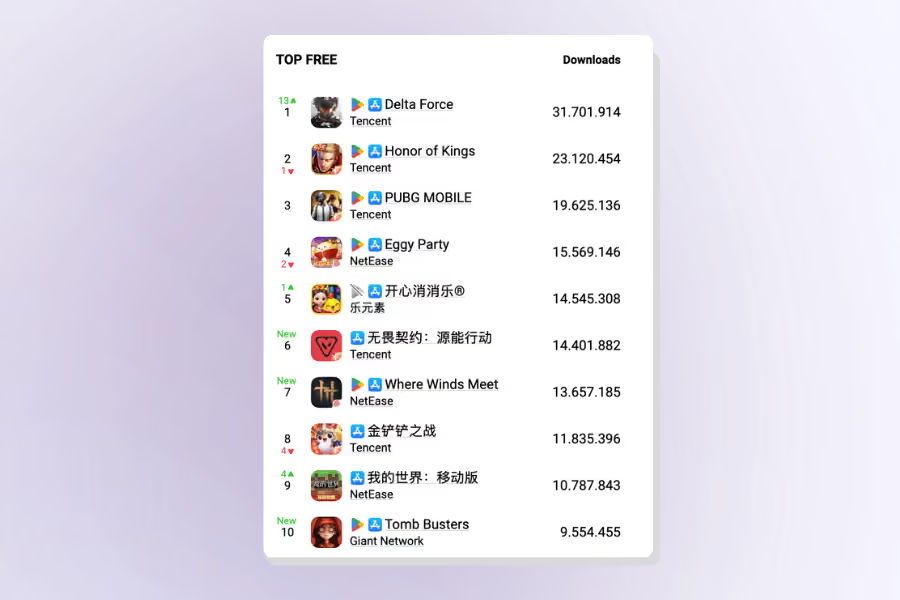
This preference is also reflected in the list of the top 10 most downloaded mobile games in China. In fact, 5 out of these 10 games belong to the shooter and MOBA categories. In 2025, the three most downloaded games in China were:
When it comes to revenue, mid-core games hold the throne.
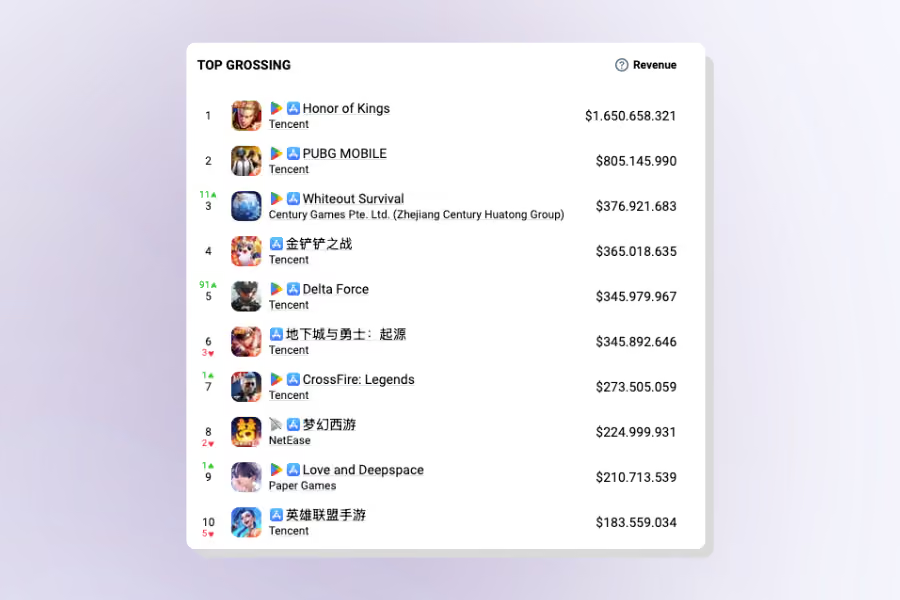
Currently, the three top-grossing mobile games in China are:
With over $100 million in monthly revenue, Honor of Kings is practically a cultural phenomenon in China. This MOBA title has been sitting at the top of the Chinese revenue charts for years. Although its gameplay mechanics resemble League of Legends, this game gained an early advantage by going mobile in 2015, while League of Legends didn’t introduce its mobile version until 2020.
Because of their distinctive characteristics, you can’t approach Chinese mobile gamers the same way you do in the West. Here are the top things you should know about them.

“China is a uniquely complex market with high regulatory and operational barriers, but for companies that build strong local relationships (guanxi) and commit to long-term localization, the growth potential is extraordinary”, Eric Lyu, Account Executive APAC, Mistplay
When asked what motivates them to play mobile games the most, 36% of Chinese players said competitiveness (Mintegral).
They even prioritize competition over game quality, so you know just how important a role it plays. This is supported by the fact that almost all games on the Chinese top-grossing charts include some kind of PvP gameplay. Therefore, if you want to increase your chances of climbing the top charts, make sure to introduce a competitive mode.
Right now, WeChat mini-games are an incredible opportunity to break into the Chinese mobile gaming market. The most popular games on the platform are casual and hypercasual games, so if that is the genre of your game, then you’re already one step ahead.
WeChat provides official development tools and APIs, that you can use coding, previewing, testing, and uploading your game. To actually submit and publish your game, you must register a WeChat Mini Program account on the official platform. Then, you choose the mini game type and fill in your developer/organization details.
The platform does allow individuals to register and create a mini game, but you can’t enable virtual payments unless they are a verified business or individual business license holder. So, as an indie developer, you can build and publish your game, but you cannot integrate payment directly for in‑game purchases unless you meet additional business verification requirements.
Localization is not just about translating text – it is about adding a cultural touch to the entire gaming experience. This is a process that includes activities like:
According to Mintegral’s research, 32% of Chinese players prefer games that include Chinese design and themes. To cater to this, many of the top games in China include storylines and characters from Chinese history and literature.
If you partner with popular IPs, you can minimize the need for localization. Since these games are already based on well-known franchises, Chinese players are more likely to accept them in a less localized version.
Hopefully, this article helped you better understand how the Chinese mobile games market works, and how you can plan your launch strategy to succeed in this complex (yet lucrative) market.
Want to read more insightful articles like this one? Subscribe to our newsletter and always stay up to date on the world of mobile games!