

EN

In today’s mobile games market, the average mobile game CPI (cost per install) is higher than ever before, leaving many game advertisers looking for strategies to lower it to increase revenue.
In this article, we’re bringing you a list of tried and true strategies that can effectively lower your game’s CPI. Let’s get started!
👀 Related reading: Mobile user acquisition: The modern developer's guide
Generally, one of the main causes of increased CPIs is market saturation, and the saturation in mobile gaming is no joke – especially in particular genres like hyper-casual.
However, this isn’t the only reason. In most cases, the main reason your game is getting high CPIs is that the audience didn’t like your advertising creatives. Your ad creatives are the initial point of contact with your game. As such, they need to grab the users’ attention and make them hit the install button – or your UA costs are going up.
When it comes to ad creatives, even small details can make a big difference for your mobile game CPI. The key thing is knowing which details to focus on.
To help you with this, we’ve handpicked 10 best practices for lowering mobile game CPI, tailored for casual and hyper-casual game advertisers.
The attention span of a typical user is only 3-5 seconds.
Therefore, your ad creative has only a couple of seconds to win or lose their attention. If it starts off boring, the majority of viewers will quickly close out the ad as soon as they’re able.
To prevent this from happening, don’t make the audience wait for the main action – deliver it right away. According to Supersonic, if viewers can sum up your game after watching the ad for 5 seconds, you have a strong creative.
Hyper-casual and casual game ads should be immediately understandable to a wide audience, regardless of their age or location, and relevant and representative of the actual gameplay experience.
For this reason, you need to make sure your ad clearly highlights your game’s mechanics, controls, and objectives. From the players’ perspective, this means you should address three fundamental “hows”:
However, it’s equally important not to overwhelm the viewer with information. To ensure you’ve achieved the right balance in gameplay clarity, make sure to think about the following:
Humans are visual creatures. Besides what you display in your ad creatives, it’s also important what it looks like.
When it comes to hyper-casual and casual games, it’s recommended to use an art style that appeals to a wide audience. Generally, bright and cartoonish colors tend to attract a larger audience than darker ones. Another effective way to make your ads pop is to harness the power of contrast.
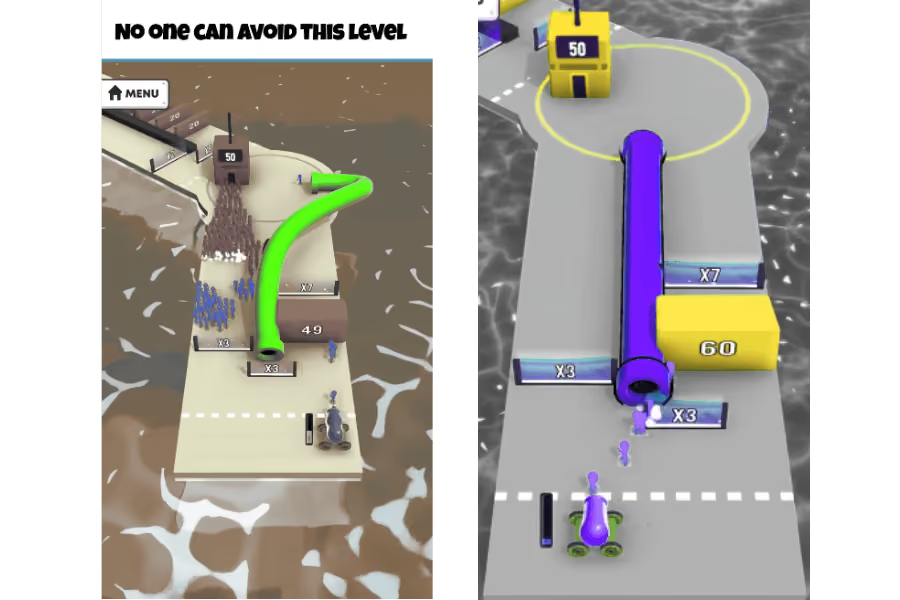
Most mobile game advertisers achieve contrast by swapping the background gameplay colors with darker tones. They then brighten up the game elements they want to highlight, such as specific characters or objects.
By highlighting these key elements, you direct users’ attention exactly where you want it, making your ads instantly understandable and impossible to ignore.
The ads that are memorable are the ones that spark an emotional reaction. That’s why you want to design your ad creatives to cause an emotional impact on the viewer, positive or negative.
Let’s say you’re using winning gameplay. In this case, you want to emphasize how satisfying it is. You can achieve this by adding affirming words, numbers, or animations to the video that add that dopamine “oomph” – like an “Amazing!” pop-up and confetti explosions.
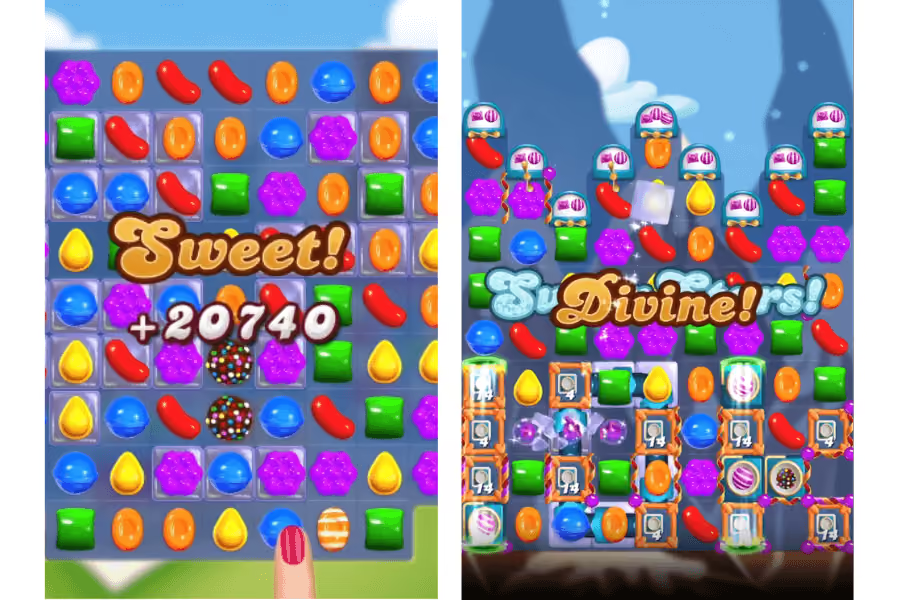
This strategy is used in famous Candy Crush Saga ads, which often contain words like “Sweet” and “Divine.” Not only do they highlight emotions, but they also lean into the game’s theme and aesthetic.

Another motion that can drive engagement is frustration.
For this reason, mobile game advertisers frequently use losing gameplay rather than winning one. If a video contains a scenario that seems like an easy win but results in a “fail”, this should trigger the viewers’ reactions.
Ideally, the “fail” should occur within the first 5-7 seconds of the video. To emphasize it, the failing scene is typically followed by a “fail” sign, blooper sounds, or red effects.
Utilizing this strategy can contribute to lowering your mobile game CPI, as it can result in these effects:

You’ve probably noticed that a lot of mobile game ads use hand animations that display actions like tapping or swiping.
This is done for a good reason, as using hands on-screen introduces players to the game controls, helping them understand how the game works.
A better understanding of the game = better conversion rates = lower CPI.
According to Supersonic, using hand animations allows them to achieve 15-20% lower mobile game CPIs.
One of the reasons this element works so well is that it adds a human touch to the creative and makes it more relatable. In our experience, realistic hand animations drive lower CPIs than cartoonish animations.
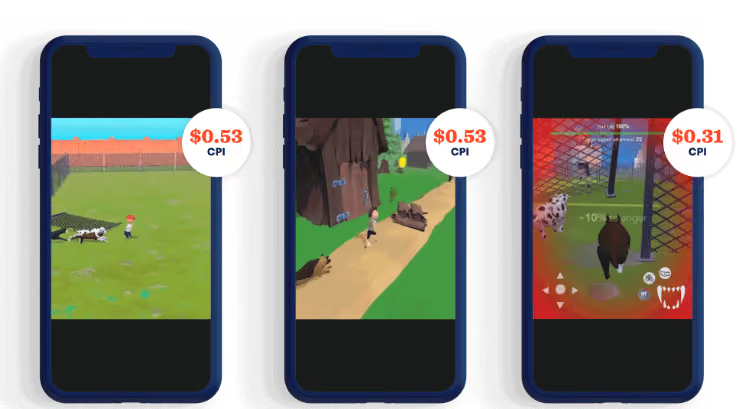
Are you only using one camera angle in your ad creatives? This might be the reason you’re not reaching your desired mobile game CPI.
Different camera angles can provide viewers with a different perception of the game. For this reason, it’s important to test various camera angles in your ad creatives. Some of your options include:
Let’s say you have a runner game. The majority of runner games have top-view gameplay. However, in this genre, you’ll often see ad creatives with the runner’s perspective angle, as this has proven to be an effective way to lower CPIs by really immersing viewers in the experience.
Remember when Squid Game took the world by storm? Many mobile gaming companies cleverly leveraged this trend to their advantage by introducing recognizable characters from the show into their ad creatives. For example, circles, triangles, and umbrellas.
The result was more attention from their target audience, which led to higher engagement rates, and ultimately – lower CPIs.
Today, there are some other trends flooding our mobile screens. On the lookout for trends, most advertisers turn to TikTok which is considered the go-to place for discovering viral content.
By keeping a close eye on the ever-changing social media trends, you can stay one step ahead of the competition. Successfully capitalizing on these trends can result in lower mobile game CPI and overall, better campaign performance.
High CPIs aren’t only a result of what’s going on in your ad creatives – the ad format you use also plays a role.
If you’re looking to decrease your mobile game CPI by testing different ad formats, try playable ads.
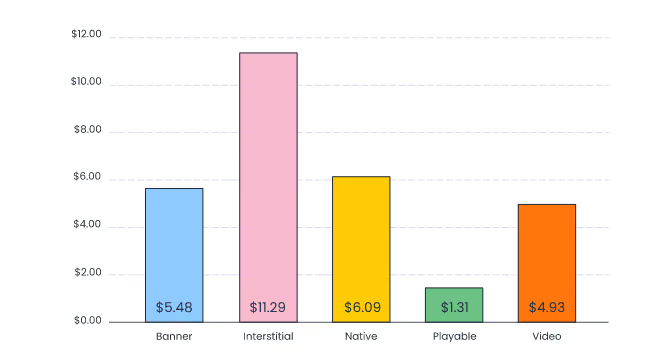
According to Liftoff, playable ads have an average CPI of $1.31, making it the most budget-friendly ad format for mobile games.
Yes, ads with fake gameplay can potentially yield lower CPIs.
But, if the majority of users get disappointed with the actual game and quickly abandon it, it ultimately drives down your ROAS (return on ad spend) and LTV (lifetime value).
While misleading ads can come at a lower cost, their negative impact on user retention usually outweighs the CPI benefits, resulting in an overall loss.
Not to mention the other possible consequences such as negative app store reviews, frustration, and damaged reputation.
Without decent retention rates, LTVs, and ROAS, low CPIs are meaningless. Learning how to lower the cost per install is just one of the steps to scaling a mobile game.
In some situations, a low CPI can be a double-edged sword. Take the previously mentioned playable ads, for example. Even though they typically have the lowest CPIs, the same research showed they also have the lowest average D7 ROAS (12%) out of all other ad formats. Therefore, when estimating their performance, it’s vital to analyze multiple metrics.
You’re confident you have a great game, but you’re struggling to scale it? Perhaps the traditional video UA networks aren’t the best fit for your game.
Instead, you might benefit from expanding your reach through the Mistplay Audience Network, which connects your game to millions of loyal users across various app categories. Get in touch with us to learn more!
