

EN

Not sure where to invest your UA budget in 2026? Don’t worry, we’ve got your back.
We’ve asked industry experts to give us their predictions for 2026, based on what they experience every day. Below, you’ll find a list of the hottest mobile advertising trends that all marketers should know about in the year to come.
👀 Related reading: Mobile user acquisition: The modern developer's guide
Rewarded as a channel has been steadily growing in importance over the years, and 2026 is going to be another pivotal year for rewarded’s share of budget when it comes to mobile growth strategies.
This is only emphasized by Playtika’s 2024 Annual Report, in which the mobile games giant reports that 50% of its users came from “incentivized marketing” like through rewarded apps like Mistplay and offerwalls.

“We have recently increased the use of incentivized marketing and, in 2024, this channel accounted for over fifty percent of the user acquisition activity within certain of our games.”
Playtika isn’t the only mobile gaming company to take advantage of rewarded advertising. This ad format – be it offerwalls , rewarded video ads, or full rewarded platforms – is becoming more and more popular as it often removes the negative sentiment caused by forced ads and turns them not only into a choice, but into a rewarding one.
According to Alexander Ruban, Mobile Gaming Marketing Executive who worked for companies like Product Madness, Wargaming, and Pixonic, rewarded UA will continue to expand in 2026, with more studios adopting it as a core part of their discovery strategy.
The Director of Sales for LoyaltyPlay South Korea, Josh Jang, confirms this as well.

“In Korea, reward-based advertising is booming. Advertisers prefer it, publishers earn more from it, and even PC sites are adopting it. This trend will only grow.”
He shares that advertisers have already started shifting their budget away from DSPs toward reward-based networks, for two main reasons:
Of course, this doesn’t mean that other ad formats will disappear, but that opt-in advertising will play a more important role alongside interstitials and banners.
And it’s not only mobile games embracing this trend. Survey apps, fintech products, travel apps, and other verticals are increasingly adopting rewarded advertising to boost engagement and retention.
In some regions, the format is evolving even further. As Tetsu Watanabe, Director of Sales for LoyaltyPlay Japan, explains, gamified loyalty systems – where users earn tiers like bronze, silver, or gold and unlock bigger payouts or exclusive bonuses – are booming right now. These mechanics could soon make their way directly into rewarded UA, enhancing user motivation and long-term participation.

“In Japan, gamified reward tiers are proving extremely effective. When users earn a status and unlock bonus rewards, it boosts engagement and loyalty. I expect these tiered systems to become a standard feature across the industry.”
This take by Pablo Perez, Senior Marketing Research Manager at Google, captures the essence of this shift: in an age where long-term goals don’t seem so unattainable, rewarding users for smaller milestones is where you succeed.
However, there’s also a side effect to this growth, and that is increased competition. Alexander Ruban thinks that, with more games allocating budget to rewarded ads, the cost of reaching the same audiences rises. Engagement numbers look strong, but in order to capture genuine product intent, developers should double down on improving quality and onboarding flow to make the most of that new-user momentum after the install.
This isn’t a new trend in mobile advertising, but it’s increasingly relevant today alongside ever-rising CPIs. While in the past, the goal for advertisers was to do anything possible to lower their CPIs, now they’re more focused on retaining users.
As it’s no longer realistic to expect to acquire a large number of quality users at a low cost, game advertisers are changing their priorities to optimize campaigns for long-term profitability. To achieve this, they pay special attention to metrics like retention, LTV, and ROAS driven from specific paid UA campaigns.
Retention insights provide a valuable snapshot into user behavior, guiding strategies for increasing LTV and ROAS. These so-called “profitability metrics” are key indicators of users’ long-term value and the return on the advertising budget. What’s even more interesting is that we are seeing a shift from D7 and D30 retention to even longer periods, like D60, D90, and even as far out as D120 and D360.
These metrics have become the guiding stars for UA managers who want to reach quality users, and we believe that this trend will persist in the years to come.
👀 Related reading: 6 essential mobile game retention metrics and how to calculate them
The use of AI in mobile advertising is nothing new, but we’re seeing these technologies getting smarter and smarter every day. So, it’s likely that in 2026, advertisers will be able to rely on AI algorithms to target their users more precisely.
What does this mean in practice?
For example, with the help of machine learning, advertisers may be able to optimize when and where the ads appear based on the user behavior or common patterns, to show ads at the best moment for each player.This hyper-personalization could lead to a different ad experience for each user, helping advertisers maximize their ROI.
However, according to Alexander Ruban, brands should rely on AI for speed and iteration, but they still need a human touch for defining style, tone and identity.

“In 2026, we will see a shift toward AI-assisted creativity. Brands will rely on AI for speed and iteration, but human direction will define the style, tone and identity. The winners will be those who use AI as part of a creative workflow, not as the final product.”
He believes that AI-generated content, which in the last year has flooded the industry, has made the audience grow even more tired of ads. That is why the companies that will stand out will be the ones that rely on human creativity again, where AI is part of the creative process and not the final product.
AI-driven targeting isn’t the only shift happening. According to Kevin Woodford, CEO of Woodford Consulting, mobile advertising will also be increasingly driven by user choice.

“Mobile advertising is becoming increasingly driven by user choice. CPA campaigns will stand out as one of the few reliable ways for advertisers to ensure their budgets reach real users who take meaningful action.”
As AI improves, he believes CPA campaigns will become one of the most reliable ways for advertisers to ensure their budgets reach real users who take meaningful actions inside an app.
This shift also aligns with the broader redirection toward user quality and long-term profitability being the primary UA focus over cheap installs.
Together, AI personalization and user-choice ad formats point toward a future where ads feel more relevant, more rewarding, and far more effective.
👀 Related reading: The AI awakening: How artificial intelligence is revolutionizing mobile gaming
According to eMarketer, in 2026, mobile video ads will account for around 40% of all mobile ad spend, while search ads will be slightly lower, 38%.
While the difference isn’t much, it’s still a great indicator of something that has shifted: people engage with video more than web pages, and advertisers are adapting.
There are different types of video ads, but UGC ads are surely among the most popular. And the reason is simple: since they are created and posted by regular creators, they are perceived as more authentic.On top of that, they often don’t feel like ads, as they seamlessly blend into the platform the viewer is using.
By definition, UGC ads are completely organic. However, in practice, there are many paid collaborations where studios pay content creators to act as real players and make videos about their games.
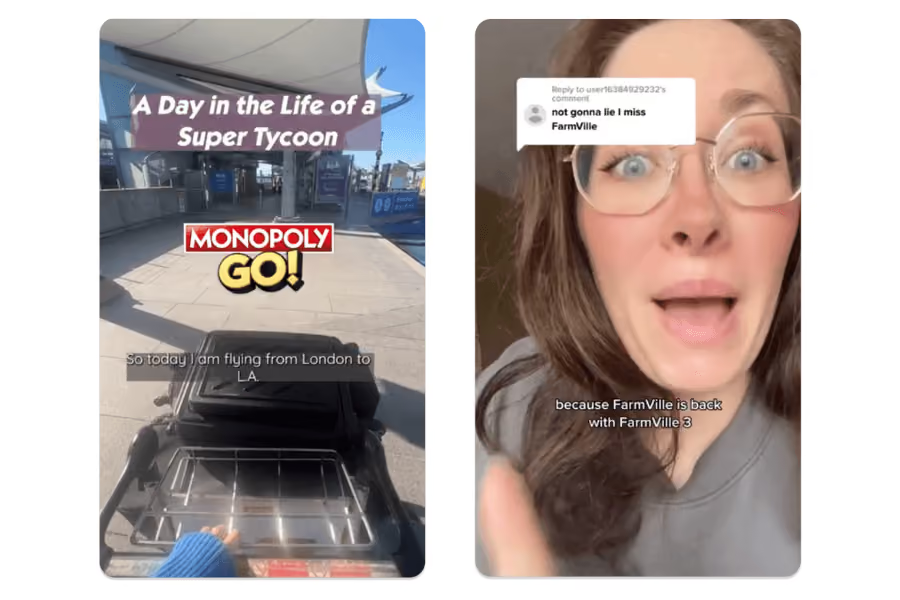
How effective are these ads? According to AppSamurai, UGC ads have 4x higher CTRs and a 50% lower CPC than standard ad creatives.
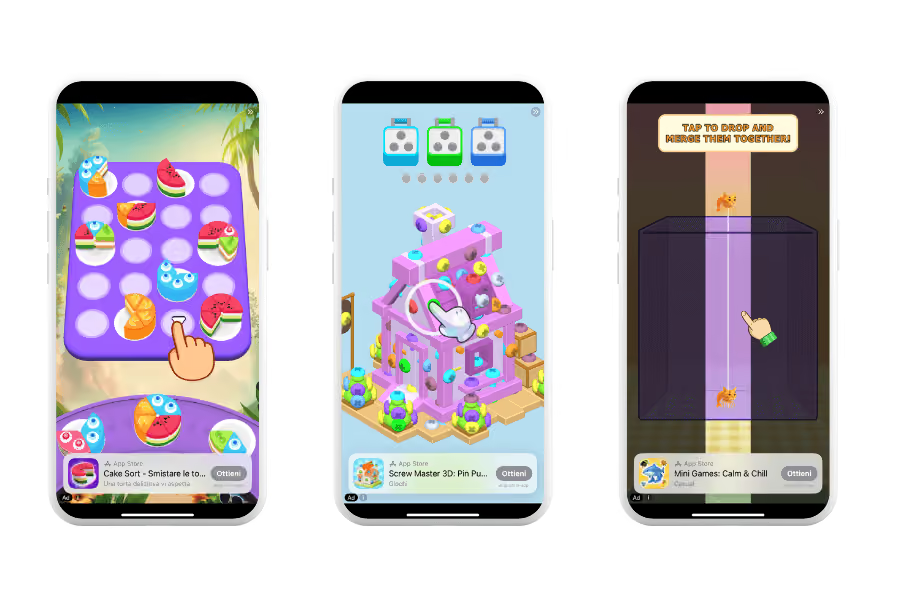
As mentioned previously, interstitials and banner ad formats are still going strong. However, we’re seeing a rise in what are called “playable ads,” which allow players to interact with the ad and try the game before installing.
For example, within the duration of the ad, you may be able to solve a quiz puzzle or play a mini-level. Interactivity is what makes these ads stand out, as while they’re still often un-skippable, they add a more appealing way to engage with the ad and get more enjoyment out of the experience.
And this shows. In fact, according to IAB, around 1 in 5 consumers will engage with this ad format and spend time with the brands advertised.
2026 is full of exciting trends growing in mobile, with likely a few more surprises and major developments to come along the way. Since the mobile industry is constantly evolving, we’re excited to see which new trends will be added to the list throughout the year.
Want more insights on the mobile advertising industry? Subscribe to our newsletter through email or on LinkedIn to stay up to date!
