

EN
Get a monthly loot box of insights straight to your email!
Subscribe
app-publishers, game-advertisers
The offerwall and rewarded advertising space has grown a lot since its early Facebook Canvas days, and it's easy to lose the through-line when you're only looking at where the industry is today. That's why we like talking to people who've been in the room since the beginning — the shifts look a lot less random once you've heard how each one connects to the last.
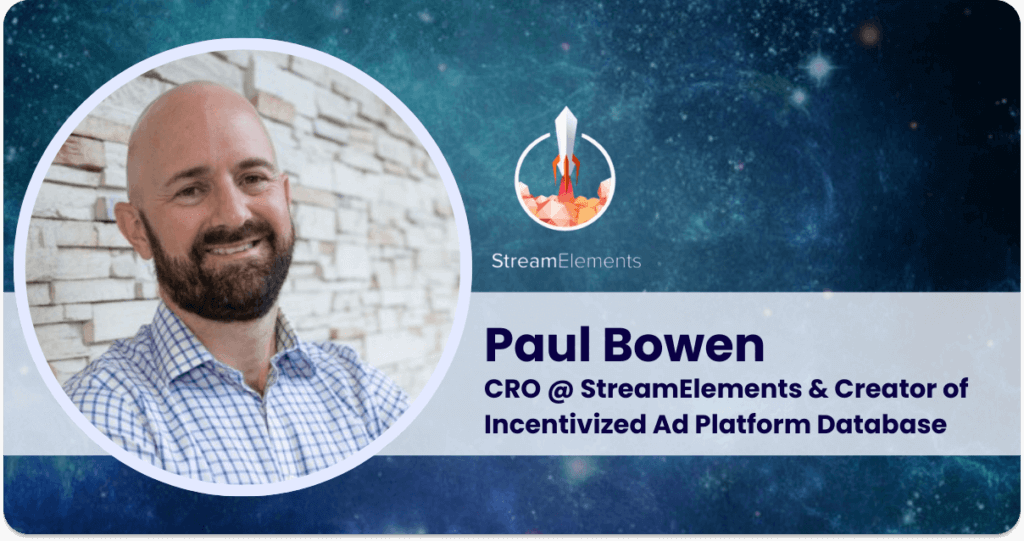
Paul Bowen has spent more than 20 years in rewarded advertising, watching it move from a niche mobile offerwall tactic to a core piece of many user acquisition (UA) strategies. We caught up with him to talk about the incentivized ad network database he built, what he looks for in a rewarded ad network partner, and where he sees the space heading next.
I’m Paul Bowen, and I’ve been working in the rewarded advertising industry for over 20 years. My career began in London, focusing on desktop advertising as a media buyer before transitioning to sales for ad networks. In 2008, while at Adknowledge, I encountered Super Rewards, a company pioneering rewarded ads on Facebook Canvas. This was during Facebook’s rapid expansion, and it became clear to me how valuable rewarded advertising could be for advertisers, publishers, and players alike.
Drawn to the space, I joined Offerpal, a Super Rewards competitor that later acquired Tapjoy. At the time, Tapjoy was a small startup innovating mobile offerwalls, enabling app cross-promotion through in-game currency rewards. I helped grow Tapjoy’s European operations and later oversaw their global team after moving to the U.S. I then spent three years at Unity, managing their ads team, and now, for the past 2.5 years, I’ve been with StreamElement. We’re an incentivized (rewarded) ad network that takes a slightly different approach by using creators to drive audiences to complete in-game actions—a concept similar to offerwalls but uniquely executed.
The idea for the database initially came from my own curiosity and later expanded to help UA managers. The AppsFlyer Performance Index is often the go-to for evaluating ad channels, but it doesn’t leave much room for smaller players alongside giants like Google, Facebook, and AppLovin.
I wanted a comprehensive view of this space—who’s operating, what rewards they offer, and how they’re performing. The database is essentially a comprehensive list detailing the rewards offered by different companies, their scale, and key properties like where their offerwalls are visible. My goal was to help UA managers understand where they might allocate their budgets in this rapidly growing space.

How has feedback shaped the database over time?
Many people in the industry, including UA managers, VCs, and company representatives, have reached out with suggestions. Companies have often asked to be included, and I would always verify their claims by reviewing their products. This feedback has been very useful, helping me refine and expand the database to provide a clearer view of who the major players are and how they operate.
It’s still a work in progress, but it’s encouraging to see the industry values having a resource that maps out the rewarded advertising landscape.
There are a few key considerations I’d like to highlight:
Finally, evaluate the network’s scale, user base, and team size to ensure they align with your campaign goals.
The core advantage is that you pay for some sort of engagement. Unlike traditional ads, where returns can be uncertain, rewarded ads ensure measurable performance.
Another benefit is that rewarded ads also deliver a better user experience compared to traditional banners or even video ads, because they don’t interrupt the user experience—users actively seek these opportunities.
Another benefit is that you don’t need to constantly produce new ad creatives, unlike social media platforms like TikTok or Facebook, which can be resource-intensive as you have to consistently “feed the beast” with new creatives. This benefit reduces UA costs over time.
I see several exciting developments ahead. In recent years, we have seen a shift from virtual currency rewards to tangible ones, like gift cards. I anticipate greater diversity in the type of rewards for the future as I assume more diverse apps will adopt this model. Think, for example, of an airline app that rewards its users with airline points.
Next, campaign windows are also expanding. Some already span 128 days, and I wouldn’t be surprised to see year-long campaigns soon. Additionally, I expect machine learning to play a larger role in optimizing event selection and pricing, tailoring campaigns to individual user behavior.
Lastly, I expect offerwalls to become more time-sensitive and potentially integrated into live-ops. This integration could create a time-dependent rewards system that would drive higher urgency and engagement.
I’m really curious to see how Facebook and Google respond to these ad platforms. There are rumors that they’re not too happy with the Playtime model, where ad networks track gameplay by recording screen activity and measuring playtime. With app stores under increasing pressure to open up, it’ll be interesting to see how this evolves.
Another question I keep coming back to is: how many people are genuinely interested in discovering new games and earning rewards like gift cards for playing?
It’s hard to know for sure, but I suspect there’s a natural ceiling to this market. Understanding where that ceiling lies—and how ad networks might adapt when it’s reached—is a fascinating topic that deserves more exploration.
That said, the rewarded advertising model is very creative, so I’m confident we’ll see innovative solutions if challenges arise down the road.
Paul's read on the space lines up with a pattern we keep seeing: rewarded advertising keeps evolving because it's built around real engagement rather than passive impressions, and that's what gives it room to stretch into new reward types, longer campaign windows, and more live-ops-style timing. It's also a useful reminder that fraud prevention and pricing strategy deserve as much attention as reach when you're choosing a rewarded partner.
Don’t miss our next interview – subscribe to our newsletter!