

EN

You might have heard that the leading mobile game studios are changing their approach to user acquisition. Many of them are no longer focusing on CPI (cost per install) as the primary metric. Instead, more and more app and game marketers are focusing on another metric – mobile app marketing ROAS (“return on ad spend”).
In light of this shift, the leading ad networks have included ROAS optimization in their campaign options. In this article, we’ll go over everything you need to know about this campaign type, from its benefits to how it works.
👀 Related reading: Mobile user acquisition: The modern developer's guide
ROAS (return on ad spend) is a revenue KPI that measures the effectiveness of app campaigns. It tells app advertisers how much revenue they generate for each dollar spent on advertising. In other words, it shows how valuable the acquired users are. Naturally, the higher the ROAS, the better.
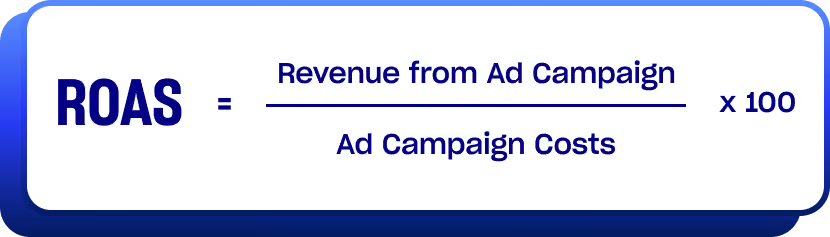
The formula for calculating ROAS is simple: divide the ad campaign revenue by its costs and multiply by 100. Let’s say an ad campaign brought in $4,000 after spending $1,000 on ads. That’s a $3,000 profit or a 300% ROAS. For every dollar spent on the campaign, the advertiser earned $3 in revenue.
App marketers usually measure ROAS for different timeframes. For example, day 3 ROAS, day 7 ROAS, day 14 ROAS, day 30 ROAS, and so on. Each of these data points helps advertisers understand the cohorted user’s behavior and value over time.
Up until recently, CPI was the “holy grail” of user acquisition. Most app and game marketers were focused on acquiring as many users at the lowest possible CPI. However, CPIs have been rising steadily over the last few years: according to Adjust’s The Gaming App Insight Report (2026), CPIs in 2025 rose by +30% compared to the previous year.
Alongside rising CPIs, there are also oversaturated ad networks, inflation, and privacy changes. All these factors made marketers rethink their old approach to user acquisition and consider new strategies beyond CPI optimization. The strategy that gained the most traction is to focus on metrics that reflect user quality, such as ROAS.
While many advertisers wonder about what the benchmark for “good” ROAS is, the truth is that there is no definitive answer to this question. A good ROAS depends on a variety of factors, including the app or game category, its monetization strategy, target audience and market, and more.
A common rule of thumb is the 4:1 ratio, meaning for every dollar spent on advertising, you should earn four dollars back. However, this ratio may vary depending on the monetization model.
Let’s take mobile games as an example.
So, if a 5% D7 ROAS may be a good benchmark for a midcore game, the same would not be true for a hyper-casual game, which would aim at a D7 ROAS of 7-8%.
Now that you’re familiar with the ROAS definition and what made it so popular, let’s talk about how you can optimize for this metric.
ROAS optimization for your mobile app marketing is the process of maximizing the return on ad spend in UA campaigns. There are two main ways to do it:
While most app and game marketers are familiar with the first approach, the second one is relatively new. It has gained popularity in recent years when ad networks like Facebook Audience Network and Google Ads introduced ROAS optimization as a campaign type.
At Mistplay, our clients can leverage our tROAS campaigns. When setting the campaign, they decide on a target ROAS, and our platform automatically adjusts their bidding to reach that target. For example, Playlinks achieved a +36% D7 ROAS thanks to tROAS campaigns and was able to scale its game in South Korea.
Finally, note that most leading ad networks support ROAS optimization for both ad revenue and IAPs (in-app purchases). In some of them, they appear as separate campaigns, while others unify total app revenue.
Whether you go for option 1 or 2, one thing is certain – when you’re looking for how to improve ROAS, ongoing optimizations to your campaigns are necessary. Optimizing for your ROAS target has a long list of advantages, including:
As we mentioned earlier, ROAS campaigns are a relatively new option available for mobile advertisers, so you might be curious about how they work. To help you gain a clear understanding of these campaigns, let’s outline the main steps of the process.
When advertisers first start using an ad network, they can’t immediately launch a ROAS campaign because the ad network needs to collect enough data on app users.
In this phase, the ad network gathers information on user behavior, preferences, engagement patterns, and in-app activities. This is basically a training phase where the algorithm used for machine learning absorbs conversion data. Based on this data, the ad network can identify users who are most likely to interact with ads and continue using the app beyond the install.
Once the ad network has the data it needs, you can get started with ROAS campaigns. In this process, you’ll need to set a target ROAS.
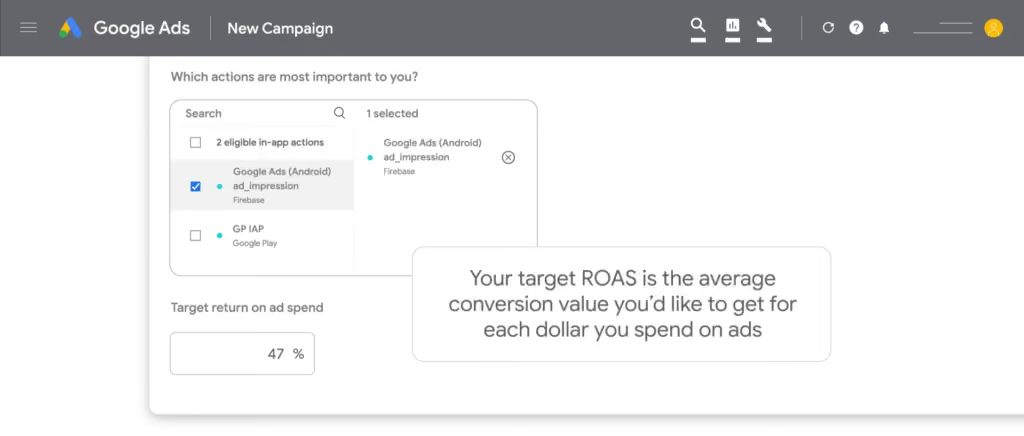
The target ROAS is the foundation of your campaign, informing the ad network about the return you expect from your ad spend. The ad network then uses this target to optimize ad placements and bids to achieve the desired ROAS.
To set the target ROAS appropriately, take into account your app’s historical ROAS performance and your LTVs. Generally, the target ROAS should be close to the actual ROAS of your app.
It’s also recommended to tailor the target ROAS for different countries. For example, it’s a good idea to aim higher in markets like the US because this campaign type has proven most effective there.
However, avoid setting an overly ambitious target ROAS. While it might be tempting to shoot for the stars in these markets, this won’t get you anywhere. Aiming too high with your target ROAS will most likely limit your campaigns’ reach and won’t yield the desired results.
As long as ROAS campaigns remain active, the optimization process continues.
To achieve a maximum ROAS, these campaigns continuously collect data, adjust targeting, and optimize ad placements. Throughout this process, the machine learning algorithm keeps refining itself, focusing on getting high-quality users to meet the desired ROAS target. This leads to mature data and stable campaign performance.
As we mentioned before, ROAS optimization heavily relies on machine learning and AI. Since we live in a world where these technologies advance rapidly, we can expect further enhancements in ROAS optimization as well, such as more sophisticated targeting and personalized ad experiences.
Playtime Events, which we launched in March, is a clear example of this approach: it combines the predictability of playtime with the depth of events. This combined approach is designed to provide advertisers with a "best of both worlds" solution: playtime brings in high-volume engagement, while events provide more flexibility. The results we’ve seen show an increase in average spending and better ROAS for advertisers:
We also expect even more advertisers to optimize for ROAS. Today, app and game businesses are diversifying their UA strategies. They advertise on different channels and run various campaign types, such as running ROAS campaigns parallel to CPI campaigns and offerwall campaigns.
In this kind of setup, ROAS is an important metric to track across channels and campaigns, because it shows how effective each of them is in driving high-value users.
All in all, it’s safe to say ROAS optimization is currently one of the hottest UA strategies among app and game advertisers as the industry pulls out all the stops to maximize ROAS. In today’s market, the focus is on profitability and user quality – and ROAS is the ideal metric to track and optimize for both. Whether you decide on classic optimization or ROAS campaigns, you’re in the right place to reach quality users.
If you need some help along the way, we’d be happy to help. At Mistplay, we specialize in ROAS-optimized campaigns to attract and retain high-value users for your game or app. Reach out to us for more information!
