

EN

Over the past few years, false advertising in mobile games has become a popular trend – so much so that mobile gamers are starting to wonder if they can sue mobile advertisers for it.
But why are fake ads so popular, and are they actually allowed? In this article, we will give you answers to all of these questions, tips on the right approach to your UA creative, and more.
👀 Related reading: Why you shouldn’t be scared of paid user acquisition
False advertising in mobile games is a type of user acquisition ad or creative that portrays gameplay, stories, or mechanics that don’t actually exist (or barely exist) in the real game. These ads are specifically designed to grab attention, whether through drama, puzzle-solving, exaggerated graphics, or even fake gameplay.
You’ve probably seen them: an ad where a man is stuck in a flooded bathroom and you have to pull the right pin to save him, or a queen is in rags and you have to drag-and-drop the right outfit to help her impress a prince. It looks appealing and strikes an emotional cord that inspires you to download the game to try to achieve what the player in the ad couldn’t
But then you download the game and it’s a match-3 puzzle that looks (and plays) nothing like the ad.
Even though they are not technically false advertising, “fail” ads can also fall under this category, since the perception is similar. Just like their name suggests, fail ads are ad creatives that feature losing scenarios. In these ads, a “player” engages with the game, but their attempts are so unsuccessful that the viewer is tempted to play the game to do better.
But it’s not just about losing; it’s more about how they lose. For example, fail ads often feature a player choosing between two options, and consistently selecting the wrong one.
Players have learned to distrust and dislike this trend. According to our 2025 Mobile Gaming Loyalty Index, “ad-to-gameplay alignment” is the second-most important factor for a player when choosing a new mobile game. Over one-third of players (36%) report that the ad creative must match the real gameplay experience after install for a player to stay engaged with the game.
What is considered a fake mobile game ad exactly? These are all ads that involve content that is unrelated to the game they are supposed to represent. Some forms of fake mobile game advertising are more common than others, so you may notice some recurrent patterns.
These ads typically display a game character that needs rescuing. The character is surrounded by movable pins, and the players’ moves determine their fate. The pins usually block some kind of threat like water, toxic waste, lava, or monsters. In other cases, they stand in the way of indispensable items for the protagonist, such as a weapon or a tool. Next, the onscreen hand (the player) pulls a pin to try and save them. In a lot of cases, they make the wrong move.
The pin-pulling mechanic is also known as “how to loot”. It was originally designed specifically for advertising purposes, not for actual games.
These fake mobile game ads display characters in situations that can be fixed. For example, a broken chair, sudden rain, or escaping jail with security cameras.
To resolve these issues, the player gets a selection of items to choose from. Once they pick out an item, they need to drag it to the character. One of them is usually completely logical, while the other one isn’t. In a lot of cases, the “player” selects the wrong item and the next thing that appears on the screen is a big “FAIL” sign.
This ad type works similarly to drag-and-drop action ads. The main difference is that, here, the characters are placed in some kind of extreme situation. For example, they are starving in a desert, need to escape a fire, etc. The player’s task is to “play the hero” and rescue the characters. For that to happen, they need to choose the right item from the selection they get.
Judging by their ads, one might think that there are many mobile games with impressive 3d graphics. However, some companies run ads that are completely untrue to the game’s look and feel. For example, cinematic ads that resemble movies or series.
Exaggeration doesn’t just appear in the form of graphics, but also in ad storylines. Some game advertisers use overly dramatized ads just to catch people’s eye. In reality, these stories have almost nothing to do with the advertised game.
Hyper-casual games are not immune to false advertising either. In ads for hyper-casual games, we can frequently see some misleading practices. This includes captions like “only 1% can solve this”, “99% will fail”, “only 2% reach green color”, etc. Some other popular misleading phrases convince players the game is incredibly difficult. For example, “you can’t do this”, “you are not able to save the hero”, and “don’t try this”.
All these captions are merely attention grabbers, and they are obviously not true. When it comes to those about reaching a certain color, this color is frequently not even in the ad. Yet, we can’t say that all such ads are completely fake. The ads for hyper-casual games usually feature actual gameplay or make it at least similar to the one in the game.
Wherever there is a mobile game that uses fake ads, there are also some angry reviews in its app store listings. Despite that, a lot of game advertisers never back down from this approach. Here are the main reasons why false advertising in mobile games is so popular.
Even if as many as 95% of players abandon a falsely advertised game in the first 5 minutes, there will still be 5% that will continue playing it. This can be a sufficient percentage to make this strategy profitable. As long as the CPI (cost per install) is low enough and ARPU (average revenue per user) is high enough, the advertising strategy is sustainable.
However, one metric advertisers need to keep an eye on is the ROAS (return on ad spend), which measures the revenue brought by a specific ad campaign. If many users download the ad from a false ad campaign yet churn before making any IAP or watching in-app ads, the ROAS may be too low to make it an effective campaign.
A lot of games are based on tried-and-true mechanics that have been popular for years, like puzzle games. The problem is, when people see ads with such mechanics, they frequently don’t pay much attention to them. To avoid this, marketers use fake ads to give games shiny new packaging, and create a new emotional reaction that breaks through the exhaustion of seeing the same type of ad over and over again. For example, by creating cinematic ads filled with captivating stories.
Moreover, some fake mobile game ads are appealing because they are incredibly weird. By looking completely off, over-the-line, or simply wrong, some users will engage with them just to check what’s going on.
Getting noticed in the overcrowded mobile game market is difficult, especially for small studios. Large companies have more resources, power, and a strong brand. All of this gives them an advantage when promoting new games. For this reason, small or new studios often decide to use deceptive advertising to stand out from the competition through “shock value” and put their new games in the spotlight.
False advertising that exaggerates the gameplay and scenarios can trigger an emotional response from viewers. For example, ads where the player constantly fails are designed to frustrate people. Frustration is a strong emotion, and when it strikes, people usually become determined to prove their point. In this case, viewers can deal with their frustration by downloading the game and outperforming the “person” in the ad.
With the help of fail ads, game marketers can trick people into thinking a game is either super easy or super challenging.
Let’s say they want to produce two completely different ads for the same puzzle game.
These two fail ads will attract players with different interests. While the first will most likely attract people looking to relax, the second might appeal to those looking to challenge themselves.
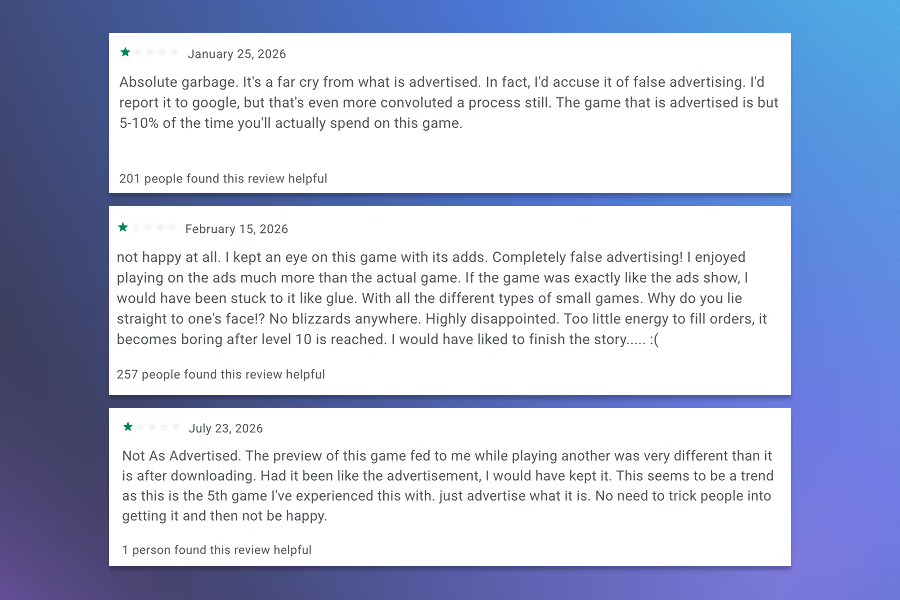
If all this talk about false advertising made you want to consider it, you should know that this strategy can backfire. Here are just some negative consequences this practice can bring:
There are several reasons why advertisers are allowed to use fake advertising for their mobile games:
However, there are real consequences for mobile games that go too far. In 2024, the Advertising Standards Authority (ASA) upheld a complaint against Top Games for false advertising – specifically on the basis that the gameplay for Evony: The King’s Return did not accurately reflect the gameplay experience.
This isn’t the first example of this type of case either, and the ASA continues to uphold that mobile game ads must reflect the "game's core gameplay experience" otherwise it may be deemed misleading.
Yes, fake game ads are still a trend, and they are evolving. With more and more players complaining about fake ads, advertisers and app owners are becoming extra dedicated to camouflaging this practice.
They do it by extending the illusion that the game is as advertised, for example introducing snippets of fake gameplay in the entire onboarding process – from app store screenshots to tutorials and mini-games.
TikTok is the channel where fake advertising has become more sophisticated than on any other channel.
Some creators leverage false claims to promote mobile games. For example, they share gameplay footage and say things like “This is actually like in the ads”. By doing this, they trick people into downloading the game. When players find out that these videos were misleading, this naturally results in a lot of backlash for both the creator and the game.
All things considered, using fake ads to lure people into downloading your game is never a wise choice. While you might get a high number of new downloads, it’s unlikely that these new players will stick around and continue playing for a long time.
We know that reaching a quality audience is difficult, especially in a highly saturated market like this. But what if we told you that there is another way?
With Mistplay Audience Network, you can reach new loyal players in the apps they already use daily. Your game will be presented within the loyalty and rewards ecosystems of our app partners, putting your title in front of users who are actively engaged and motivated to earn.
Interested in learning more? Check this page or reach out to us for more details.