

EN
November 20, 2026

brands-retailers
As a retailer, you know that building customer loyalty is a long process. Customers need to trust you, and you need to become their first choice among a sea of other shops and e-commerce. Loyalty programs are usually the first answer to this need, but they are ubiquitous: in a market of more than 25 million online stores worldwide,1 67% of retailers admit to having one, and another 29% plan to launch theirs over the next months.2
Modern retailers also know that showing up at the moment of transaction isn’t enough anymore, because your rewards and discounts are competing with what everyone else does, and this is visible in consumers’ behavior: the average US consumer is enrolled in more than 10 loyalty programs,3 but actively uses only 2 or 3.4 This means that people enroll, maybe cash out their welcome reward, and then leave.
In this article, we explore a new approach for retailers who want to engage their customer base through loyalty. What if, instead of rewarding customers for what they do for your brand, you reward them for a habit they already have?
🚀 Boost engagement between purchases with LoyaltyPlay
Most loyalty programs rely on the same levers, which can be included in three main categories:
While these examples are effective, you may also notice how they require the customer to do something high-intent for your brand.
In a 2005 paper,5 Professor Ran Kivetz explained the principle of promotion reactance. Rewards can trigger psychological reactance in consumers, who may feel bribed and threatened in their personal autonomy (“I need to do this to get the reward”). Instead, when a reward matches their effort, they see it more as a personal choice (“I’m doing this because I value the activity or product”).
This points to a useful distinction between two types of reward: passive and earned rewards. While passive rewards are handed to the customer – like a welcome bonus or a birthday discount – earned rewards come from the customer’s effort into something they value. “Earned” here doesn’t mean earned by spending, but the effort is the activity itself, and the reward follows from it.
The takeaway isn’t to leave behind traditional levers, but to avoid relying on just one. Customers differ in what feels worth the effort. For example, one shopper happily signs up to your newsletter for a discount, while another would rather spend a few minutes on something fun.
A program with several ways to earn lets each customer choose the path that feels like their own decision, which is what reduces friction.
👀 Read also: How to build your retail loyalty program (without heavy discounts)
Since earned rewards can be more appealing to customers, several apps have already expanded the way they reward user loyalty by rewarding app engagement and aligning to existing habits. For example:
As you notice, the rewarded habits align to the brand mission and values: Adidas rewards an active lifestyle, Walgreens healthy habits, and Fetch daily shopping. But while the type of rewards may differ, this approach has two positive benefits:
Let’s see why this works.
As mentioned above, forcing your customers to build a new habit just to get a reward can introduce friction and potentially a negative brand experience, but relying on an activity that they already do removes that friction altogether – and just adds a moment of delight on top of their regular routine.
Moreover, you’re not tying the reward to money, but to the time spent in something they would have done anyway. This earn-without-purchase approach allows you to reach all the segments of your user base, even those who generally don’t interact with your loyalty program.
The effect is a higher redemption rate, which is up to 35x* higher than standard points. While people may have a tendency not to redeem points and to stockpile them,6 rewards that come from personal effort lead to stronger redemption choices7 and, consequently, higher AOV.

“The value comes from time already being spent on something fun and engaging. Retailers can use this to rebuild trust with lapsed and infrequent customers, rewarding the time they’re already spending instead of asking for money they weren’t ready to spend in-store.” – Jennyfer Taylor-Glick, Head of Customer Success at Mistplay
*From LoyaltyPlay data
Earned rewards can help you fill the lost engagement and downtime between purchases for your retail customers. It all comes down to adding more value to your loyalty experience in a low-friction way that aligns both with your brand and what your customers value. By transforming your app into a place of discovery for new rewards, your brand can also benefit from:
Of course, not every habit fits every customer base. Workouts work perfectly for sportswear brands, and steps can easily be transformed into miles. But what if you want to reward an activity that most of your customers enjoy?
Mobile games can be a fit for earned rewards. In the US, 65% of adults play mobile games weekly, so by adding a rewarded gaming layer inside your app, you can reach some of that interest. And if you think that mobile gaming is too distant for your brand, just know that many big retail names – from Sephora to Starbucks – have introduced gamified experiences inside their loyalty programs, as a means to boost user engagement.

“Do not ask a shopper to build a new habit for your program. Use the one they already have. Over sixty percent of US adults play video games every week, and mobile is the most popular way they play. That session happens every day, with you or without you.” – Anthony Gartung, Senior Business Development Manager at Mistplay
Adding a rewarded gaming layer doesn’t mean you need to rebuild your entire loyalty program: it’s an easy solution to implement, and you can start testing it in no time to see how it benefits your shopping app. Here is a way to test it that keeps what already works untouched:
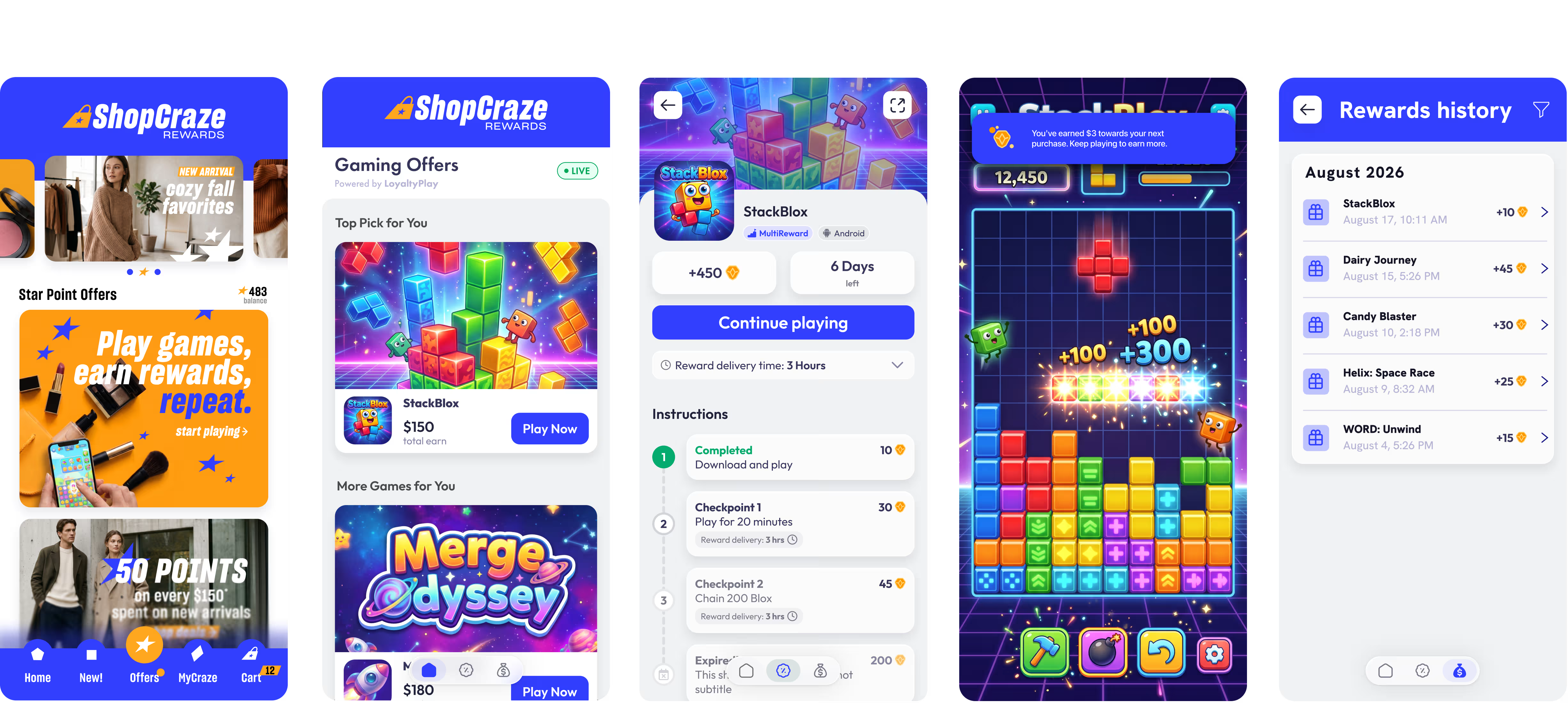

“By having gaming, we now have the opportunity to reach the consumer in that in-between shopping-trip moment, get them engaged, and get them to actually use the app probably twice as much as before, because they don't necessarily have to spend anything to get rewarded. Our strategy is to really focus on how we create micro-actions to bring the consumer in more often." – Carolina Paradas, US GM, ShopBack
Looking for new ways to engage your customers is no easy task, but earned rewards can help you turn some of that downtime into new engagement with your brand.
If you’re curious to test it out, Mistplay can help. Our LoyaltyPlay rewarded gaming hub was designed to foster customer loyalty and engagement through mobile gaming, without disrupting the reward experience your brand already offers.
Reach out to us to set up your first test.
Sources